From Early Acceptance to Deeper Reach: Why Claude for Healthcare Matters in Autism Care
AI did not enter autism care slowly because the field was hostile to technology. It entered cautiously—and then, once it demonstrated the right posture, it normalized faster and more broadly than many expected.
Autism care is a demanding environment for any new tool. Clinical judgment is individualized. Documentation carries real reimbursement and audit consequences. Accountability is fragmented across clinicians, operators, payors, and families. In that context, skepticism toward AI was less about fear of innovation and more about protecting the integrity of care.
What’s notable in hindsight is not resistance, but how quickly AI gained a foothold once it showed respect for clinical reality.
Claude for Healthcare, launched by Anthropic, is best understood against that backdrop. Not as a reset after failure, and not as a sudden breakthrough—but as a signal that AI’s role in autism care is ready to expand beyond its initial, well-earned boundaries.
Hesitation was pragmatic, not defensive
Early clinician hesitation toward AI in autism care is often overstated or mischaracterized. Clinicians were not broadly opposed to AI. They were cautious about tools that appeared to abstract away nuance, standardize judgment, or quietly shift accountability.
In a field built on individualized care, discretion, and therapeutic relationships, that caution was rational. Clinicians wanted confidence that AI would support their work—not redefine it or expose them to new forms of risk they could not see or control.
Once that confidence emerged, adoption followed quickly.
How AI earned trust faster than expected
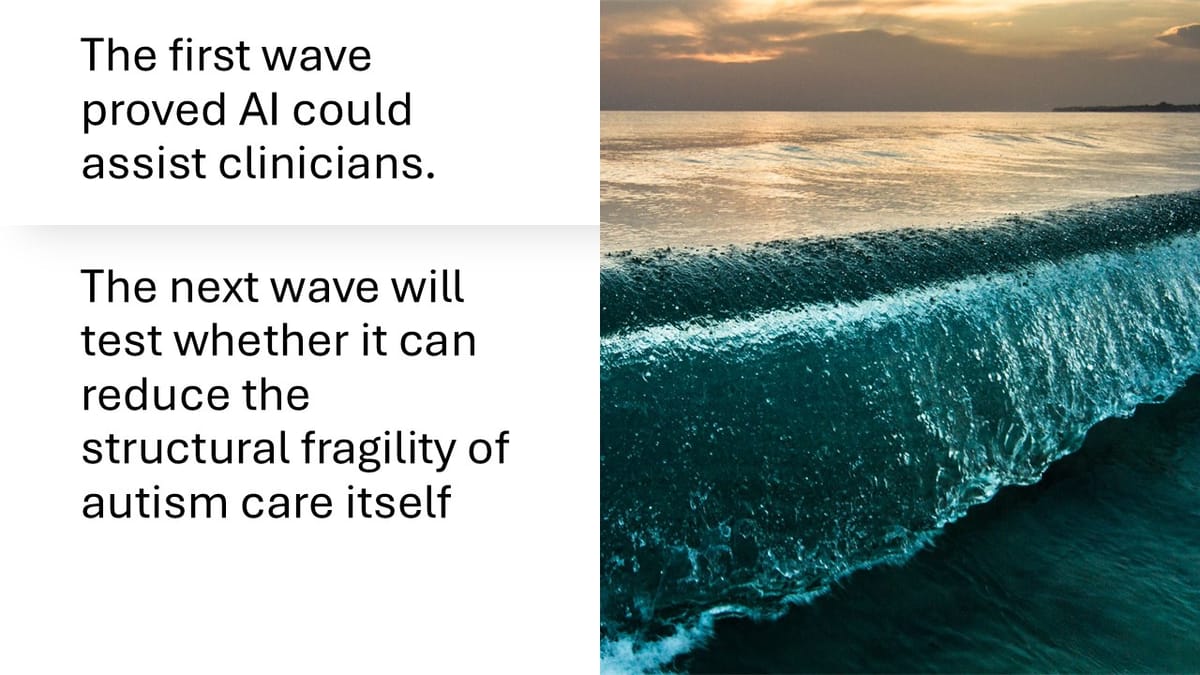
The first wave of AI adoption in autism care succeeded precisely because it behaved conservatively.
AI gained acceptance when it:
- Supported clinical session notes without taking authorship away
- Preserved clinical voice and decision-making authority
- Reduced after-hours administrative burden
- Flagged issues without adjudicating them
Claims checking and documentation validation tools followed the same pattern. They did not replace billing teams or clinicians; they acted as early-warning systems that improved reliability without shifting responsibility.
The key insight is not that clinicians “gave in” to AI. It’s that AI adapted to clinicians.
Once that alignment was clear, AI stopped feeling experimental and started feeling normal.
Where the first wave naturally stopped
Despite that momentum, early AI adoption clustered in predictable places:
- Notes after sessions
- Checks after claims
- Analysis after outcomes
Not because those were the only opportunities—but because they were the safest places to start.
The most consequential operational risk in autism care is causal, not temporal.
Failures are rarely introduced where they are discovered. They are created earlier—through documentation choices, rule interpretation, and data handoffs—and only surface later as audits, denials, or compliance exposure.
Concretely, that risk shows up when:
- Documentation is authored without sufficient rigor at the point of care, even though the failure is only revealed weeks later under audit
- Charts appear operationally complete, but lack the specific elements payors scrutinize downstream
- State- or plan-specific rules are interpreted incorrectly during intake or authorization
- Credentialing or service-mapping mismatches silently invalidate care that otherwise looked compliant at delivery
These are not downstream problems in origin. They are causally upstream decisions with delayed consequences.
Historically, AI tools avoided this layer not because it was unimportant, but because it required reasoning across ambiguity, conflicting rules, and human accountability—conditions where being “mostly right” is still too risky.
Why Claude for Healthcare marks an expansion point
This is where Claude for Healthcare matters.
The significance is not that Claude is more intelligent, but that it is designed for constrained environments. It can reference authoritative policy sources, interpret structured and unstructured clinical records, validate identity and credentialing data, and operate in HIPAA-ready settings while explicitly surfacing uncertainty and requiring human confirmation.
In practical terms, Claude is being built to function inside the same constraints humans already manage—rather than assuming those constraints away.
That design choice expands the set of workflows AI can responsibly participate in.
A later illustration: chart review as a second-wave seam
Tools like Brellium appear later in this story for a reason.
Brellium’s focus on chart review and documentation quality assurance illustrates what becomes feasible once AI can reason across policy, records, and documentation without pretending certainty. Chart review is operationally painful, directly tied to reimbursement and compliance, and historically too risky for automation.
Claude-class capabilities make partial automation here plausible—not because risk disappears, but because uncertainty can be surfaced, explained, and contained with humans firmly in the loop.
Brellium is a useful illustration of where this next layer of trust is being applied.
What this next phase actually represents
This is not a shift toward AI “running” autism care.
It is a shift toward more of the operating stack becoming addressable:
- Prior authorization readiness
- Appeals preparation
- Credentialing validation
- Intake handoffs
- Scheduling constrained by clinical and contractual rules
The constraint is no longer whether AI can be accepted. That question has largely been answered.
The constraint now is whether systems are designed to:
- Make uncertainty visible
- Preserve human accountability
- Respect regulatory and financial realities
The real signal
The real signal in Claude for Healthcare is not adoption speed or vendor positioning. It is that the boundary of what AI can responsibly participate in is expanding.
AI earned trust in autism care faster than many expected by behaving conservatively.
The next phase will test whether that trust can extend deeper—without breaking the principles that enabled adoption in the first place.
That’s not a story of struggle.
It’s a story of disciplined progress.