How AB Spectrum Designed a Tech Stack for Growth

Most technology strategies begin with software.
What practice management platform should we use?
Which CRM?
Which HR platform?
Should we build or buy?
At AB Spectrum, those weren't the first questions.
Technology mattered. It just wasn't the starting point.
Instead, the leadership team began by defining the kind of organization they wanted to build. Only then did they ask what operating model would support that vision—and finally what technology would best enable it.
Technology wasn't the strategy.
It was an expression of the strategy.
As a member of AB Spectrum's leadership team responsible for translating that vision into day-to-day operations, Ahad Hosseini thinks about operations the way a landscape architect thinks about a piece of land. The design doesn't start with what you put on the land. It starts with understanding the land itself—and only then deciding what belongs where.
AB Spectrum appears to approach technology the same way.
Start with the Business
Many organizations treat technology strategy as an IT exercise.
AB Spectrum treated it as an operational one.
The leadership team first became clear about the organization's mission, vision, and strategy. From there, they designed an operating model around the experience they wanted children, families, and staff to have.
Only then did technology discussions begin.
That sequence became a filter for every major technology decision.
Instead of asking whether a platform had a particular feature, the question became:
Does this help us operate the way we want to operate?
Manage Kids, Not Appointments
That philosophy becomes most visible in one simple statement.
"We're not managing appointments. We're managing kids."
Most practice management platforms naturally organize work around appointments.
AB Spectrum intentionally works backward from the child's experience.
That perspective aligns with the organization's inspiration from the Reggio Emilia approach, where environments are designed around the child rather than expecting every child to adapt to a standardized process.
The same philosophy extends beyond clinical care.
How should families experience intake?
How should information flow across departments?
How should staff collaborate?
Only after answering those questions does technology enter the conversation.
Design the Architecture, Then Choose the Technology
Once the operating model became clear, the technology decisions became much easier.
Ahad describes the philosophy this way:
"Just as a landscape architect studies the movement of water before deciding where to plant a tree, organizational architects should study the movement of information, decisions, and people before deciding which software to buy."
Rather than expecting a single platform to run the business, AB Spectrum adopted a different architectural philosophy.
Each platform has a clearly defined role within the operating model.
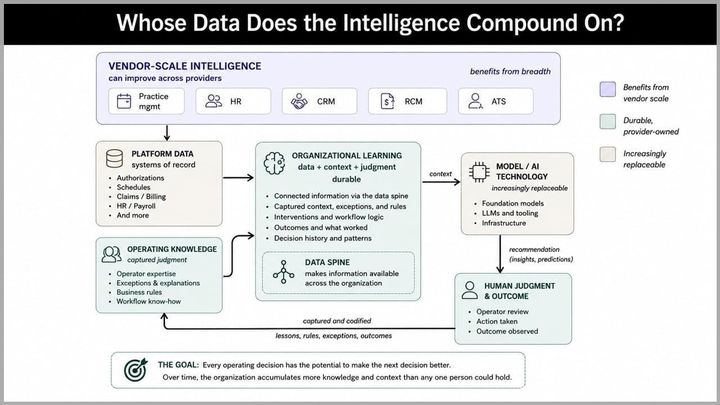
Rather than asking one application to own every workflow, each platform is selected because it excels at a specific operational capability, while a centralized data architecture connects those capabilities into a cohesive operating environment.
That philosophy allows the organization to standardize where standardization creates value while preserving the flexibility to innovate where innovation creates value.
The Decisions Reflect the Operating Model
When evaluating client engagement, the discussion wasn't simply about replacing a CRM.
Leadership first defined the role a CRM should play in the family's journey—from the first inquiry through intake, diagnostics, insurance verification, enrollment, and ultimately a seamless transition into the organization's practice management platform.
That ultimately led to the selection of LeadSquared.
One example is parent onboarding. Rather than asking families to create accounts, manage passwords, and navigate multiple disconnected forms before services even begin, AB Spectrum redesigned the experience around a simpler, mobile-first workflow using one-time passcodes, centralized intake, and a smoother transition into care. The CRM became more than a lead management tool—it became the front door to the organization.
The same thinking extended into workforce operations.
Rather than focusing only on payroll and HR, leadership evaluated onboarding, account provisioning, role-based access, and reducing operational friction as the organization grows.
Those questions ultimately led to Rippling. Leadership understood the implementation would require a meaningful investment, but viewed that investment as building long-term operational infrastructure rather than simply deploying another HR system.
Again, the technology wasn't the story.
The decisions were.
Better Decisions Require Better Visibility
Executing an operating model is only half the challenge.
Leaders also need to know whether it is working.
AB Spectrum has invested heavily in a centralized data architecture and business intelligence environment, allowing operational data from across the organization to be brought together around leadership decisions rather than around individual systems.
The objective isn't simply better dashboards.
It's better questions.
Technology executes the operating model.
Data helps leadership continuously improve it.
When Technology Creates the Conditions for Growth
Over the past year, AB Spectrum has grown revenue by approximately 30%, expanded its leadership team, continued growing without private equity, and reduced its intake timeline from roughly sixteen weeks to four. Leadership also describes stronger operational visibility and exceptionally strong BCBA retention.
No single technology deserves credit for those outcomes.
What stands out instead is the consistency of the decisions behind them. Rather than allowing technology to shape the business, AB Spectrum first defined the business it wanted to build—and then selected technology to support it.
Like a landscape architect, the leadership team didn't begin by choosing individual components. They began by studying how information, decisions, and people move through the organization—and designing an environment where children, families, and staff could thrive.
Technology didn't shape the landscape. The landscape shaped the technology.