Operator Spotlight on Jaybird ABA: Designing a Clinician-First Practice without Leaving the Floor
Across the ABA landscape, different operating models solve different problems. Some are designed for rapid expansion, others for standardization, and others for administrative efficiency at scale. At the practice level, however, a more practical question tends to matter most: how does an operating model shape where clinical leadership actually spends its time?
Jaybird ABA drew my attention because it reflects a deliberate alignment between a clinician’s values, the structure of the practice, and day-to-day execution. This Spotlight is not intended to generalize that model beyond its context, but to examine how it is working for one provider and why those choices matter in practice.
At the center of Jaybird is Nicola Brummer, a BCBA who set out to build a practice that preserves clinical integrity, supports staff doing the hardest work, and expands access in underserved communities—without pulling leadership away from the floor.
When Experience Makes Tradeoffs Visible
Before launching Jaybird, Nicola worked as a BCBA in both nonprofit and private-equity-backed ABA organizations. Over time, she saw a familiar pattern emerge.
As her organizations grew, decision-making migrated away from the clinic floor. Supervisors became stretched thin. RBTs cycled out. Clinical leaders were expected to protect quality while absorbing increasing administrative and operational load.
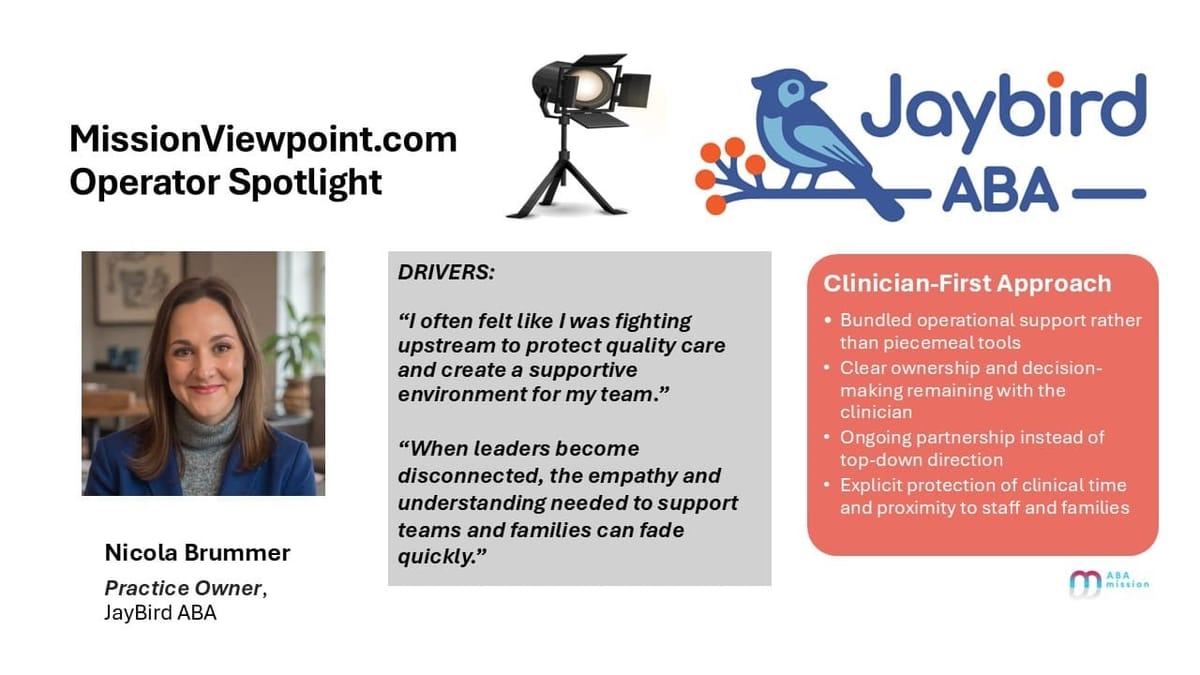
“I often felt like I was fighting upstream to protect quality care and create a supportive environment for my team,” Nicola said. “When leaders become disconnected, the empathy and understanding needed to support teams and families can fade quickly.”
Practice ownership had crossed her mind—but the operational reality felt like it would recreate the same tradeoff in a different form: more control paired with less clinical presence.
A Clinician-First Operating Model, Observed in Practice
In conversations with clinicians across the field, a consistent tension comes up: independence often means inheriting administrative responsibility that quietly displaces time spent supervising, mentoring, and supporting care teams.
What made Jaybird worth examining more closely was the operating model Nicola chose to build around. Rather than approaching independence as “going it alone with software,” she aligned her practice with Finni, a clinician-first operating model designed to absorb operational burden early while preserving clinical ownership and decision-making authority.
In practice, that model emphasizes structural choices that change how leadership time is allocated:
- Bundled operational support rather than piecemeal tools
- Clear ownership and decision-making remaining with the clinician
- Ongoing partnership instead of top-down direction
- Explicit protection of clinical time and proximity to staff and families
This is not a franchise structure, and it is not private equity. It is a distinct approach to practice operations that prioritizes where leadership attention is spent.
Jaybird provides a concrete example of how those structural choices show up in day-to-day operations.
Designing the Practice Before Delivering Care
Rather than retrofitting systems later, Nicola chose to put operational infrastructure in place first. The intent was straightforward: prevent leadership drift before it starts.
For her, the most immediate operational unlock came from hiring and candidate screening.
Without support, initial screening calls alone can consume 10–15 hours per week—time pulled directly from clinical work, supervision, and culture-building. By absorbing the front end of the recruiting funnel, the operating layer not only returns that time to the clinician-owner, but allows leadership to focus energy where it matters most: evaluating candidates who are genuinely aligned with the practice’s clinical values, expectations, and culture.
“That’s one of the toughest parts of the job,” said Nicola. “I don’t have time to take random calls while I’m in session or supervising. Having that layer handled means I can focus on candidates who are actually a good fit for our culture and expectations—and stay present with my team and clients.”
The value is not abstract efficiency. It is leadership time deliberately redirected back to supervision, mentoring, and care delivery.
How Jaybird Is Intentionally Operating
Jaybird’s operating choices reflect Nicola’s priorities and lived experience in the field.
Leading From the Floor
Nicola does not believe in “desk BCBAs.” She remains directly involved in sessions, supervision, and clinic life.
“I want to lead from the floor, not from a distance,” she said. “That’s how you understand what your staff and families are actually experiencing.”
This proximity informs decisions that might look inefficient on a spreadsheet but matter deeply in practice.
RBT Support as Infrastructure
Jaybird is structured to maintain coverage and reduce burnout. When sessions cancel, staff are supported through alternative contributions or flexible options rather than being sent home by default.
The effect has been a tightly connected team that supports one another—and a practice that has avoided client cancellations due to staffing gaps.
“If we don’t take care of RBTs, we can’t deliver services,” Nicola said. “They’re doing the hardest part of the job.”
Early Intervention as a Starting Focus
Jaybird initially focused on early intervention clients as a conscious design choice. The goal was to protect quality and depth while the practice took shape—not to define a permanent ceiling.
As the practice evolves, Nicola wants the flexibility to expand thoughtfully, including serving older clients and exploring broader collaboration. The early focus reflects sequencing, not limitation.
Navigating Reality: Payors and Access
Like every ABA provider, Jaybird operates within real payor constraints. Contracting—particularly in Medicaid and managed care environments—remains one of the most significant sources of friction.
The clinician-first model does not eliminate those realities—but it changes who absorbs them, and at what cost.
Operational support provides visibility, communication, and structured problem-solving—allowing leadership attention to remain anchored to families rather than consumed by opaque processes.
This distinction is especially meaningful in rural communities, where access gaps are not theoretical and delays have immediate consequences.
Why Jaybird Matters
Jaybird ABA is not a case study in rapid scale. It is an example of intentional alignment.
It shows how an operating model can shape where leadership energy goes—and who benefits from that shift. By absorbing administrative friction early, the model allows a clinician-owner to remain present, empathetic, and grounded in the realities of care delivery.
That is why Jaybird stood out. Not because it represents a universal answer, but because it demonstrates how fit—between values, structure, and execution—can materially change the experience of staff, families, and clinical leaders.
And that story, in this field, is worth examining closely.