Provider Profile: Action Behavior Centers
Snapshot
Most recent review: February 2026
Provider Name: Action Behavior Centers
Footprint: Multi-state
Scale: Enterprise, multi-site platform
Care Model: Clinic-based ABA services with early intervention concentration
Growth Posture: Private equity–backed expansion platform
Operating Context
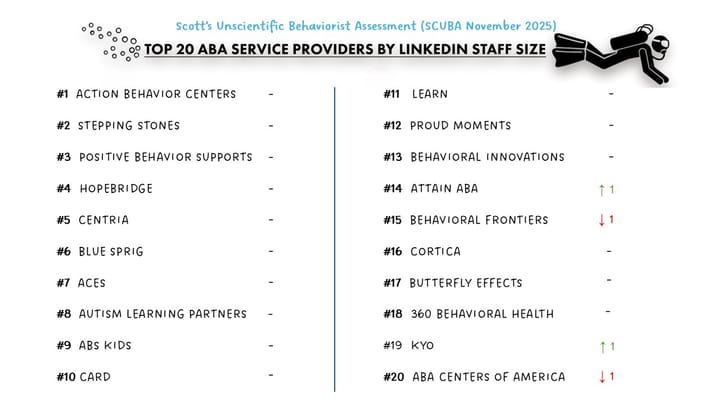
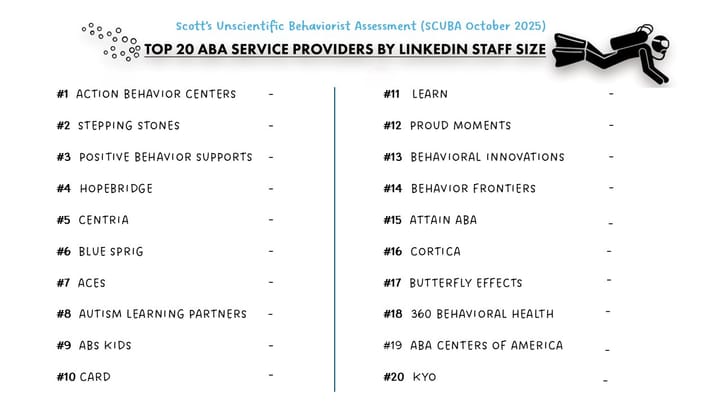
Action Behavior Centers (ABC) represents one of the most fully developed clinic-replication models in autism services.
The organization operates a standardized, center-based model designed for geographic replication across markets. Public-facing positioning emphasizes centralized infrastructure, consistent clinical architecture, and operational repeatability across locations.
Unlike founder-led regional groups expanding organically, ABC operates as a capital-backed enterprise platform. Its ownership structure implies institutional expectations around unit economics, disciplined market entry, and scalable administrative systems.
Operational Signals
Staffing & Supervision
ABC’s public messaging suggests structured clinical hierarchy and centralized support functions, consistent with a supervision model designed to scale across physical centers rather than adapt case-by-case at the site level.
Intake & Access
The clinic-heavy model indicates intake pipelines optimized for predictable, center-based enrollment—particularly early-intervention cohorts—where capacity planning and census stability can be tightly managed.
Recent expansion of school-age programming (ABC Academy) introduces a secondary delivery layer that increases model complexity beyond pure early intervention. This suggests a measured broadening of age mix within the clinic framework.
Scheduling & Delivery
A predominantly clinic-based footprint implies centralized capacity management, physical-site utilization controls, and repeatable launch playbooks for new centers.
Revenue / Payor Context
Multi-state operations require navigation of heterogeneous payor environments.
ABC has publicly engaged in Medicaid reimbursement discussions in Texas, signaling a willingness by enterprise-scale providers to influence reimbursement structure rather than passively operate within it. That posture differentiates large platforms from smaller regional providers with limited policy leverage.
Technology Signals
Practice Management / Clinical Documentation: CentralReach (https://www.actionbehavior.com/resource/blog/why-we-use-centralreach-to-track-progress-in-aba-therapy?utm_source=chatgpt.com)
Operations / Care Delivery: Not publicly specified
Use of a mainstream enterprise ABA PM/EMR platform further supports ABC’s standardized, replicable clinic model rather than a self-developed or bespoke tech strategy.
This aligns with your analytical focus: it’s a signal about model standardization and integration with common industry infrastructure, not a technology deep dive.
Why This Provider Appears in Coverage
Action Behavior Centers is tracked as a structural reference point for:
- The clinic-replication thesis in ABA
- Capital-backed expansion dynamics
- The operational durability of large, standardized center models under payor pressure
Changes in ABC’s expansion cadence, service mix, or reimbursement posture are likely to reflect broader shifts in the enterprise segment of autism services.
Disclosure
This Provider Card is based on publicly observable information available at the time of writing. Public materials may lag real-time operational changes, particularly during periods of growth, restructuring, or system transition.