The Missing Data Dimension in Autism Care
Medicaid reimbursement pressure dominated nearly every conversation I had at AIS West 2026.
Over three days in Scottsdale, I met with dozens of providers, platform leaders, investors, and operators. The financial strain on the autism services ecosystem is real and accelerating. But underneath the reimbursement discussions, the conversations kept circling back to something that rate adjustments alone will not solve.
Rigid fee-for-service models were never built around individual differences. Outcomes frameworks still lack industry-wide alignment, leaving payors without a consistent standard to evaluate against. Authorization scrutiny increasingly assumes a level of standardization the field has not achieved.
The reimbursement problem is downstream of an outcomes problem.
And the outcomes problem runs deeper than the datasets providers currently have access to.
The Conversation That Reframed It for Me
An unplanned conversation with Calvin Portley Jr. reframed the issue in a way I had not fully considered before.
Calvin is Chairman of Pivotal Parenting, an L.A.-based ABA provider, and also leads commercial efforts at Neurolutions/Kandu, which develops brain-computer interface technology for stroke rehabilitation. During our discussion, he walked me through how those devices measure not just what a patient can move, but what the brain is actually doing during recovery.
That distinction matters more than I initially realized.
In cardiology, hepatology, and nephrology, medicine understands those systems well enough to establish measurable biological baselines. Clinicians can trace a relatively direct line from biology to intervention to outcome. That measurability is what makes standardized outcomes possible across much of medicine.
The brain does not yield that way.
Neuroscience has made extraordinary advances in understanding brain development, network organization, and neurodiversity. But translating those insights into measurable, operationalized frameworks for intervention response and standardized outcomes remains extraordinarily difficult.
Autism lives entirely inside that complexity.
The spectrum is not simply “wide.” Many individuals likely reflect meaningfully different underlying neurological profiles that current frameworks cannot easily distinguish. And that is what makes outcomes alignment so difficult to build.
We Have Data — But Not the Missing Dimension
The autism services ecosystem is not lacking data.
Providers already generate enormous volumes of it:
- claims data,
- treatment records,
- session notes,
- authorization histories,
- assessment results,
- operational workflows,
- and years of longitudinal intervention information across millions of children.
Even if the data remains fragmented across systems, it exists.
But what is missing is not more data volume.
It is a neurological dimension we still cannot directly measure.
What we do not have is the signal inside the black box.
In cardiology, operational and clinical data connect back to measurable biology. You can trace treatment to outcome through the body’s own readouts.
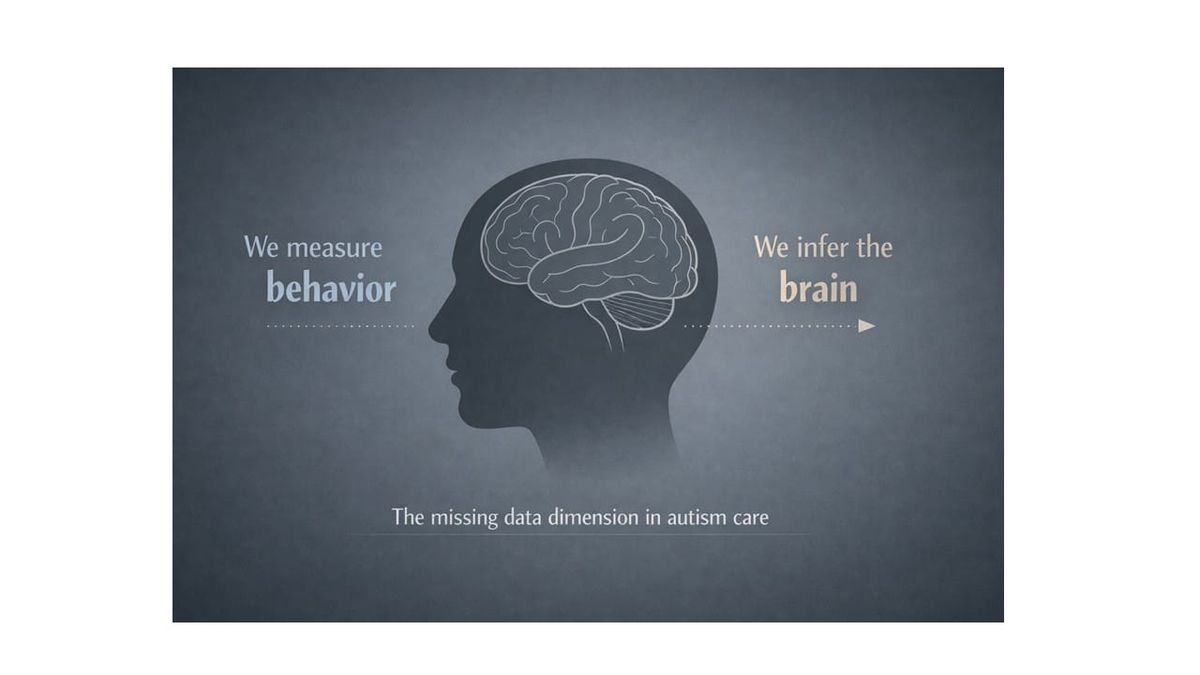
In autism care, the neurological layer that would complete the picture is largely absent from the datasets providers, payors, and platforms work with every day. We are still largely inferring neurological state indirectly through behavior, documentation, and administrative signals.
That creates enormous downstream consequences:
- for authorization review,
- for outcomes measurement,
- for medical necessity discussions,
- for reimbursement policy,
- and for how providers justify individualized care inside increasingly standardized payment structures.
The Tension the Industry Is Running Into
Until that gap closes, the industry is trying to fit a highly individualized, biologically complex condition into a standardized fee-for-service framework.
The seams are starting to rip.
Closing the gap likely requires advances in neuroscience itself. It may also require analytical models sophisticated enough to infer missing neurological signal from the behavioral and operational data the industry already collects. Most likely, it will require both.
Either way, the challenge is larger than software alone.
And it is deeper than reimbursement alone.
Grateful to the many providers, operators, platform leaders, and investors who shared their thinking across three days in Scottsdale. And to Joe Burst for hosting and making the introduction to Calvin.