Why Autism Care Is Ripe for Consolidation — and Why It Keeps Failing

Recent events — from valuation compression in vertical healthcare software to restructuring within managed behavioral health — reinforce how unsettled parts of the autism ecosystem remain. Capital markets are reassessing durability assumptions. Infrastructure bets are being recalibrated.
But even if financing conditions stabilize and enterprise platforms regain footing, provider consolidation faces a deeper constraint.
In a recent analysis, I argued that the autism platform layer itself may consolidate before providers do. Public market resets in vertical SaaS, combined with outcome ambiguity and care-model variability, have introduced fragility into the tech stack beneath service delivery.
Even if that infrastructure realigns, consolidation at the provider layer remains structurally difficult.
Consolidation in autism care makes strategic sense on paper.
- Demand continues to outstrip supply.
- Workforce shortages persist.
- Payors increasingly prefer scale, standardization, and measurable outcomes.
- Families want continuity across diagnostics, ABA, OT, ST, and mental health rather than fragmented vendor handoffs.
Given those conditions, the case for consolidation appears straightforward: larger organizations should be able to spread fixed costs, professionalize operations, invest in infrastructure, and coordinate care more effectively than standalone clinics.
And yet, after more than a decade of private equity involvement, roll-ups, and platform-led expansion, the results remain uneven.
Margins compress instead of expand. Integration timelines stretch. Clinical leaders burn out. Promised synergies fail to materialize.
The problem is not capital or strategic intent.
It is structural misalignment.
Consolidation Requires Shared Clinical Logic
Durable healthcare consolidation depends on some degree of standardization:
- Agreed-upon clinical endpoints
- Defined care pathways
- Comparable supervision structures
- Normalized productivity assumptions
- Stable revenue per episode
Autism care does not consistently have these.
Clinical outcomes are not universally defined across payors, providers, or regulators. Care pathways vary materially. Supervision intensity, progression benchmarks, and discharge criteria differ by organization and geography. At the same time, the heterogeneity of individuals on the spectrum makes rigid standardization clinically and operationally risky.
This diversity is intrinsic to the population served.
But it limits how aggressively care models can be streamlined without eroding quality or clinician trust.
When outcome definitions are fragmented, scale multiplies variation rather than reducing it.
Ownership cannot resolve that.
Ownership Is Not Integration
Most consolidations in autism care succeed at financial aggregation and struggle with operational integration.
Acquired clinics retain locally optimized workflows and supervision models. Leadership teams inherit variation without a shared clinical anchor to standardize against.
The consequences are predictable:
- Intake criteria differ across sites
- Documentation expectations vary
- Supervision ratios and structures are inconsistent
- Scheduling logic reflects different intensity assumptions
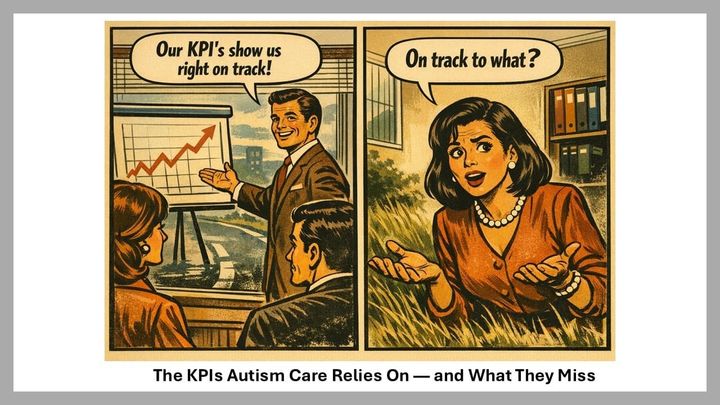
- KPIs roll up dissimilar underlying models
What appears to be scale on a balance sheet behaves like federation in practice.
This is not primarily a talent constraint. It is an integration constraint compounded by outcome fragmentation.
Why De Novo Becomes the Default
Under these conditions, de novo expansion becomes structurally attractive.
Opening new centers allows operators to extend an existing clinical and operational model incrementally rather than reconciling divergent ones. Variation is controlled at inception rather than harmonized after acquisition. Standardization can be embedded gradually within a single operating logic.
De novo growth is slower, but it carries lower integration volatility.
In a fragmented outcomes environment, that tradeoff often makes it the safer path.
Intensity Compression Increases Sensitivity
Emerging reimbursement and clinical signals suggest potential downward pressure on average authorized ABA hours. Regardless of care philosophy, lower intensity tightens unit economics.
When revenue per client declines, previously tolerable inefficiencies become financially material. Minor scheduling gaps, supervision mismatches, documentation delays, and inconsistent discharge logic begin to erode margin.
In a field without universally agreed-upon outcomes or standardized pathways, leaders lack a coherent foundation for redesigning care models under that pressure. Integration weaknesses that were masked by higher authorized hours become visible.
Scale, under these conditions, amplifies sensitivity.
The Core Misdiagnosis
The recurring mistake is treating consolidation as a financial strategy with operational follow-through.
In autism care, consolidation is fundamentally a clinical alignment challenge with financial consequences.
Capital can aggregate assets. It cannot create shared outcome definitions, unify care pathways, or reconcile supervision models across heterogeneous populations.
Until the field resolves how to align outcomes, pathways, and operating models at scale, consolidation will continue to look strategically logical — and continue to struggle in practice.