
Almost Everyone Wants to Switch. Almost No One Does.
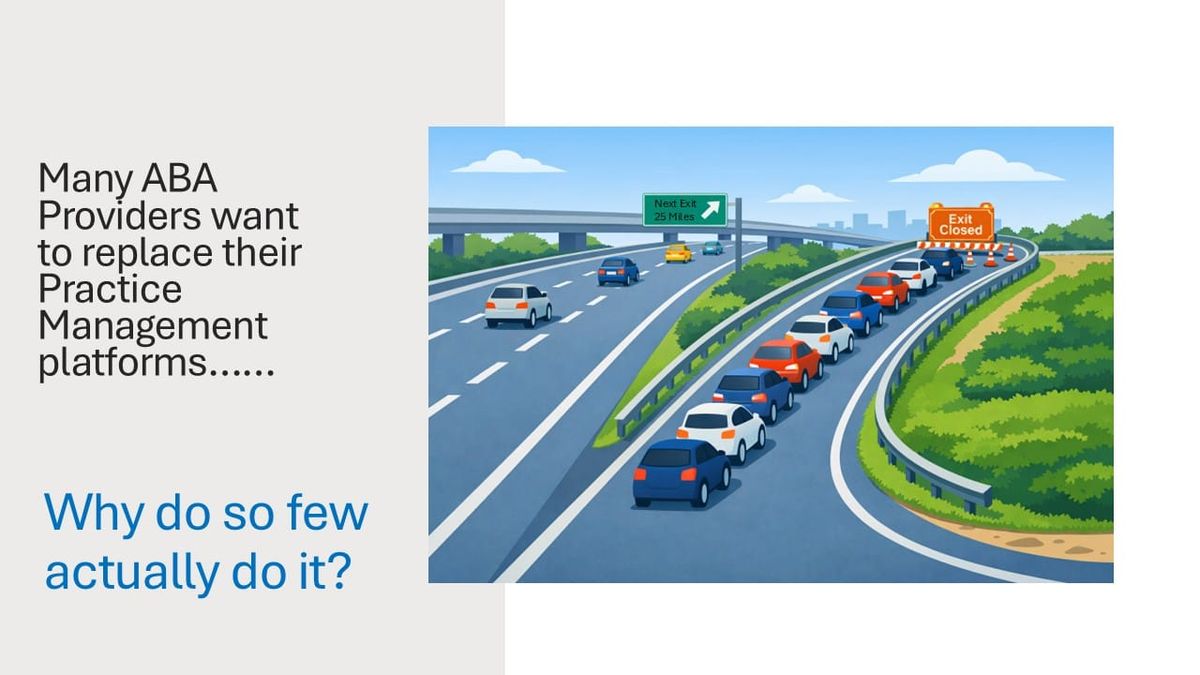
Part One of MissionViewpoint's series: The Economics of Switching Practice Management Platforms
After several hundred conversations with ABA operators over the past few years, one pattern has become hard to ignore.
Almost everyone wishes something about their practice management platform were different.
And almost none of them switch.
That gap says more about the ABA technology market than any feature comparison ever could. It isn't a story about providers resisting change or bad software. It's a story about the economics of switching—and about how rationally providers price the risk of moving.
It's worth being precise about what operators actually want, because "I want a different platform" is rarely the real sentiment.
What they want are capabilities their current technology doesn't fully provide:
- AI that is useful outside of the 'black box'
- Better reporting
- Fewer clicks
- Cleaner scheduling
- Faster authorizations
- Systems that communicate with one another.
Switching platforms is only one way to get those capabilities—and by far the most expensive. Most operators would gladly keep the platform they have if those capabilities could be added another way.
That raises the question at the center of this series: at what point do incremental improvements stop being enough?
The dissatisfaction runs the length of the maturity curve
The revealing thing about today's market is where the dissatisfaction shows up. It isn't concentrated among the least sophisticated providers. It exists at nearly every stage of technological maturity—and it's worth walking that progression, because most operators will recognize the stage they're standing in.
The holdouts. At the earliest stage, a shrinking handful of organizations still run largely on manual or paper-based processes. That group has dwindled to a rounding error, and it knows modernization is overdue. It isn't the interesting part of the story.
The stranded. A step in are providers on a platform that was once purpose-built for ABA but has since been rolled into a sprawling multi-specialty portfolio and rebranded along the way—now a minor vertical inside a private-equity holding company that's plainly investing elsewhere. The software still runs. But the roadmap no longer feels centered on autism care, and the people using it can tell.
The entrenched. Further along are the large providers who standardized years ago on the industry's dominant incumbent—the platform that effectively became the sector's default operating system. It works, but getting at their own data is hard and the integration gaps are real. Over the years they've built spreadsheets, custom reports, and workarounds to compensate, until the platform became both deeply embedded and increasingly difficult to evolve.
The builders. Others have stopped waiting on their platform and started building an operating layer around it—custom applications, decision-support tools, data warehouses, AI capabilities, and increasingly vibe-coded operational solutions that fill gaps the core system won't. Rather than replacing the platform, they're extending it.
The explorers. And at the leading edge are the providers evaluating the newest cloud-native/SaaS platforms, or wondering whether the first AI-native systems will redefine what practice management software should even be over the next decade.
Different stages. Different technology. Different reasons for wanting something better. But the same underlying wish—and notice that it runs all the way to the top of the curve. The providers on the newest, best-funded platforms are asking a version of the same question as the ones still on paper: Is this the system that carries us forward?
So why doesn't anyone move?
Nearly every one of those conversations arrives at the same question.
If you're unhappy, why haven't you switched?
Because switching isn't a software purchase. It's an organizational transformation.
The obvious costs are easy to name:
- Implementation
- Training
- Data conversion
- New integrations
- Recreated reports
- Redesigned workflows.
But those are only the visible ones. The larger expense is operational disruption.
Every mature provider has spent years adapting its business around its technology—authorization processes, scheduling rules, billing workflows, supervisory oversight, reporting, and a great deal of institutional knowledge that isn't written down anywhere.
It simply lives in the way the organization works. Replacing the platform means rebuilding all of it while continuing to deliver care every day. The license fee is often the smallest cost involved.
One observation is worth holding onto because it becomes central to the rest of this series. A surprising share of the cost of switching is self-imposed.
Many providers assume a migration means bringing everything with them—every historical record, every completed authorization, every legacy workflow.
It rarely does. The most economical migrations often move remarkably little, and deciding what not to bring is where much of the leverage lies. I'll come back to whose responsibility that should be—the provider's or the platform's—later in the Series.
Most providers talk about platform cost. The conversation should be about what it enables.
When operators explain why they're considering a change, they usually start with price.
Our costs keep going up.
We're paying too much.
We're not getting enough value.
Those are legitimate concerns—but they're the wrong place to start, because they frame the decision as a line item to reduce rather than an investment to justify.
The better question isn't "Can we spend less on software?"
It's "Can technology help us build an organization that performs differently?"
Those lead to very different decisions.
ABA has learned to treat technology as overhead, and for understandable reasons. Margins are thin, reimbursement limits investment, and clinical care rightly comes first; every technology dollar competes directly with hiring clinicians and serving families. In that environment, software naturally gets scored as a cost to control.
But the organizations that consistently build operating advantages approach the conversation differently.
They invest in technology because it enables capabilities they couldn't reasonably build otherwise—better authorization management, smarter scheduling, higher-quality reporting, decision support, automation, and AI-assisted workflows.
None of those matter because they're modern. They matter because they allow the organization to adapt faster than it could before.
The point isn't that providers are wrong to watch cost. It's that they're optimizing price when the variable that actually matters is adaptability.
The real decision depends on adaptability.
Healthcare is changing faster than it has in years. Reimbursement keeps evolving. New CPT codes are expanding how clinical work is recognized. AI is starting to automate work that recently took entire departments. Operational expectations keep rising. Care models are being re-evaluated for efficacy.
In that environment, today's feature comparison matters far less than tomorrow's ability to change.
So the question that actually decides a platform isn't "Does this meet our requirements today?"
It's "Will this let us keep adapting over the next ten years?"
That's a very different evaluation, and it's the one too few providers are running.
Adaptability doesn't come from software alone. It also depends on how well an organization understands its own operations, and no platform can create operational discipline where none exists.
The right technology partner can't hand you adaptability, but it can make it far easier for a well-run organization to keep evolving. The platform is necessary. It isn't sufficient.
That helps explain why so few providers actually switch. Most organizations aren't deciding whether another platform has better features. They're deciding whether the additional capabilities justify the cost and disruption of changing the operational foundation of their business.
That's a fundamentally different calculation than comparing software features or monthly subscription costs.
The question isn't whether another platform is better. It's whether it's better enough to justify changing the operating system of the organization.
In Part Two, I'll look at that same decision from the platform's perspective. If the economics of switching are this significant, what does a platform actually have to deliver to make the decision worthwhile?


