Your New Practice Management Platform Is Also Your Next 'Legacy' Platform
Why Every Entry Decision Is Also an Exit Decision
Part Three of MissionViewpoint's series: The Economics of Switching Practice Management Platforms
Part One argued that providers who stay on a platform they dislike aren't being passive; they're pricing risk, and most price it well, because switching isn't a software purchase but an organizational transformation whose largest costs are operational.
Part Two asked what a platform must deliver to make that transformation worthwhile, and found the answer less in features than in the total cost of change, much of which lives in the migration itself.
This final article is for the smaller group that has actually decided to move. It is not a guide to migration. Most migration advice treats a switch as a project to be executed, ending at a go-live date. That framing isn't wrong; it's incomplete.
A migration should be measured not by whether it finishes but by what it leaves behind: an organization that is either easier or harder to change than the one that started. A migration is worth its considerable cost only if it reduces the cost of the one that eventually follows.
The article turns on one uncomfortable premise: the practice management platform you are about to adopt is also the platform you will someday leave. Every entry eventually becomes an exit.
A provider choosing a new platform as the answer to today's problems is also determining the conditions of its next migration, the one it cannot yet see but can be certain is coming. The question is not simply whether this platform is better than the one you have. It is how difficult you are about to make the departure you haven't scheduled yet.
Viewed that way, a switch stops being an escape. A migration undertaken only to flee the present - the inability to integrate, the data you can't reach, the vendor that stopped investing - has a remarkable tendency to reproduce itself under a different logo.
You carry the same undocumented operations into the new system, rebuild the same workarounds, sign a contract with the same lock-in, and arrive a year later as the same organization with a different vendor and a fresh catalog of complaints. The platform changed. The organization did not.
This article is about avoiding that outcome. Not the mechanics of moving, but the handful of decisions that determine whether a migration leaves an organization genuinely more adaptable or merely relocates its rigidity.
Before You Move, Understand the Organization You're Moving
Unhappiness is not readiness. Part One established that dissatisfaction runs the length of the maturity curve; nearly everyone has a grievance. A grievance tells you something is wrong. It does not tell you that you are prepared to move. And moving before you are prepared is how providers pay full price for a switch and achieve a largely lateral (and unsatisfying) outcome.
Readiness is a more specific and less comfortable thing: understanding your own operation well enough to move it. For many providers, the honest answer is that they do not, and the migration becomes the first time they are forced to articulate how the business actually works. This is the Untethering problem in its sharpest form.
The payor-specific rules, the scheduling conventions, the authorization logic, the decisions that solved a problem years ago and were never revisited; none of that lives in the platform. It lives on in how the organization operates, much of it inside a handful of experienced people and written down nowhere. You cannot hand a receiving platform an operation you cannot clearly describe.
That is why the most valuable work of a switch happens before a single alternative is evaluated, and why it is the work most providers skip. A migration touches almost every process at once, making it one of the few moments an organization can deliberately redesign itself rather than relocate itself. But that requires first understanding how the organization operates, deciding what should change, and defining the operating model you want on the other side.
Do that work and the evaluation becomes an exercise in matching a desired destination. Skip it and you choose through the lens of your current frustrations rather than your future. Self-knowledge, in this sense, is not preparation for adaptability. It is the first expression of it.
Some organizations face a more fundamental problem: their operations are not merely undocumented but also inconsistent, having evolved differently across locations, leaving no coherent operating model to migrate. For them the first project is not replacing software but creating enough operational discipline to have something worth moving. Because a new platform cannot organize an organization that has never organized itself.
That has always been daunting, but it is becoming far less so, and next month's issue is devoted to why: AI is beginning to give providers an unprecedented ability to document how they actually work and find what is worth improving.
For a provider not ready to take that on, two options impose structure without a full switch: leaning deliberately on the legacy platform's own workflows and configuration as rails rather than fighting them with workarounds, or adopting the clinician-first platform model I've written about before, which supplies operational scaffolding along with the software.
Neither resolves the ownership questions this series has raised, but both can be the right first step for an organization that needs order before it needs freedom.
Choose the Future You're Building
Once you understand the organization you're moving, the evaluation changes. Most selections begin by looking backward, scoring every demonstration against the frustrations you already have: better reporting, cleaner scheduling, faster authorizations, fewer clicks.
Those are legitimate requirements, but also yesterday's problems. A platform that fixes everything you dislike has cleared a surprisingly low bar. Better than your incumbent does not always mean it's right for the organization you're trying to build.
The more useful question is different: what capabilities does this platform make possible that your organization won't reasonably build on its own over the next five or ten years?
Because you've already defined how you want the organization to work, the evaluation becomes an exercise in which platform best supports that future rather than which one best corrects the past. You're choosing for the organization you intend to become, not against your current frustrations.
That also means evaluating things that rarely appear in a demonstration. Roadmaps matter, but execution matters more. Ask how consistently the vendor has delivered against its roadmap, how mature its implementation methodology is, and whether your data will remain accessible.
Most importantly, understand the vendor's philosophy about where organizational capability should live. Some platforms are designed to own as much of the workflow as possible; others to connect to capabilities providers increasingly own themselves.
Neither is universally right, but it should be a deliberate choice, because it determines where your reporting, automation, and AI are likely to live over time.
The question is no longer whether the platform solves today's problems, but whether it will still support the organization you're building after those problems have been replaced by new ones. This means choosing a platform is also choosing the conditions under which you'll someday leave it.
You Are Always Signing Two Contracts
The moment of choice is where the entry-is-exit idea becomes practical. Adopting a new platform means operating, for a time, under two contracts at once: the one governing your exit from the current platform, and the one governing your eventual exit from the new one. Providers attend to the second as a purchase and forget the first is still shaping the migration ahead.
The legacy contract governs your exit, and it was almost certainly written against it. Most migrations end not with the old platform shut off but with it demoted. Active work moves to the new system while the old one becomes a historical archive, kept so records remain available when a payor, an auditor, or an attorney eventually asks.
How long that access must last is not a guess; it is set by real obligations. The longest is the one providers most reliably forget: employment and labor exposure (especially in California), which reaches back years on a clock unrelated to payors and points straight at the scheduling and time data the old platform holds.
Too often those terms were never negotiated, and the result is paying operational pricing for what is now historical access, or discovering too late that affordable access was never in the agreement at all.
None of which makes the renegotiation easy. A legacy vendor has little incentive to convert a full-price operational contract into cheap read-only access, and many resist. Two things are shifting that calculus.
The first is reputational: lock-in is no longer a quiet norm but an increasingly visible one, and no vendor serving autism care wants to become its example while the sector is under this much public and regulatory scrutiny.
The second is that the requirement is becoming less dependent on the incumbent at all. A growing set of service vendors will extract data from a legacy platform and host it on a cloud system that preserves access to most of what an auditor, attorney, or payor would later look for.
The future contract deserves equal attention, because the day you sign it is the day you hold the greatest leverage you'll ever have with that vendor. Self-service data exports, reasonable historical-access pricing, and practical notice periods cost little to negotiate before the relationship begins and become very difficult to obtain once you've announced your departure.
Even with a legacy contract, it is best to redo these terms at a natural contract renewal event, not in a rush when you're about to leave.
Every entry decision is also an exit decision. The providers who understand this negotiate their freedom to leave on the day they arrive, when that freedom is least expensive, rather than discovering its price years later when they can least afford it.
Migrate Intentionally
Once the platform is chosen and both contracts negotiated, the migration itself becomes smaller than it first appears. Part One observed that the most economical migrations move remarkably little, and the mechanism is ordinary: new authorizations open in the new platform while those already in flight run to completion in the old one.
The boundary between systems isn't an arbitrary go-live date; it moves naturally through the practice as authorizations renew, until the legacy platform holds no active work at all. You didn't migrate the open work. You let it drain.
That boundary creates something more valuable than a simpler implementation — the chance to decide what deserves to make the journey. Every mature provider carries years of accumulated workarounds, hand-maintained reports, and records that will never be referenced again, and a migration is one of the few moments an organization can set those down instead of faithfully rebuilding them.
That is why execution rarely determines whether a migration succeeds; it simply reveals whether the earlier work was done well. Every undocumented workflow and every exception understood by one experienced employee eventually surfaces during implementation.
Organizations that understood their operations meet those moments as decisions; those that didn't meet them as emergencies. And under pressure, emergencies almost always produce the same response: rebuild what already existed. The irony is that migrations meant to transform an organization often recreate it instead, one recovered workaround at a time, arriving on a new system with the old constraints intact.
Own the Capabilities That Differentiate You
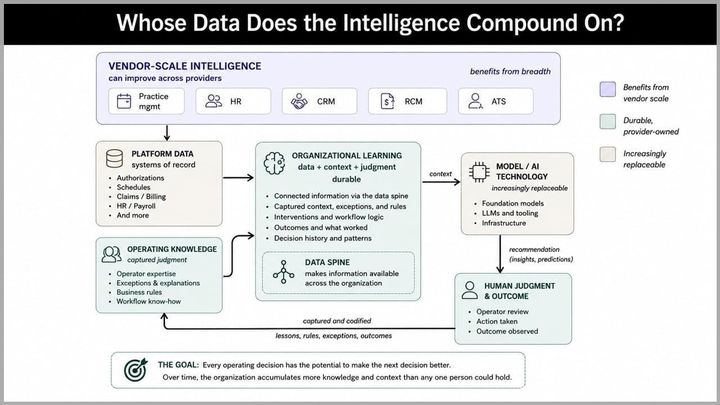
Everything to this point lowers the cost of switching at the margin. The largest reduction, however, isn't negotiated in any contract. It's architectural. And it has run through MissionViewpoint's earlier work on the operating layer and the data spine, even before this series turned to switching.
The providers with the lowest switching costs are often not the ones on the newest platforms. They're the ones that deliberately separated organizational capability from platform capability, keeping their reporting, business intelligence, CRM, workflow automation, and increasingly their AI and decision logic outside the practice management system.
Portability is one benefit of that architecture, but not the deepest. The deeper question is ownership.
A capability that exists only inside the platform belongs, in every practical sense, to the platform; it travels with you only if you can rebuild it, and the moment the vendor changes direction, ownership, or roadmap, part of your competitive advantage changes with it.
A capability the organization has built outside the platform belongs to the provider. It survives vendor changes, migrations, and acquisitions.
That is why the operating layer quietly changes the economics of switching. A provider whose reporting, intelligence, automation, and AI already live outside the platform isn't migrating its organization when it changes systems; it is replacing the system of record beneath a set of capabilities it already owns and intends to keep.
Every capability moved out of the platform reduces the cost of the next migration before it is ever contemplated. Adaptability isn't bought during a migration. It is accumulated in the ordinary years between them, one capability at a time.
What the Series Was Actually About
Three articles, one subject.
The first theme article asked why providers so rarely switch and concluded the answer was not inertia but economics: changing an organization's operational foundation is expensive, and staying was often rational.
The second theme article asked what a platform must do to earn that decision, and found not a longer feature list but a lower total cost of change.
This third article asked how a provider that does switch avoids rebuilding the same constraints on a new platform — and answered that the platform bought today is also the one that will someday be replaced, so every entry decision is also an exit decision.
Those questions look different. They're really about the same thing: adaptability. Clinical care will keep changing, reimbursement will evolve, AI will reshape operational work, and platforms will consolidate and eventually be replaced.
The providers that build lasting advantage won't be the ones that happened to choose the best software at a particular moment, because software advantages depreciate. Advantage comes from owning the capabilities that sit above the platform.
Organizations that understand their operations, choose deliberately, negotiate with future exits in mind, and own their reporting, automation, and AI reduce how much has to change when the next platform arrives. Over time, switching stops being an organizational transformation and becomes what it should have been all along: an ordinary technology decision.
That is where this series ends. It began as a discussion about replacing practice management software and ends somewhere larger. The greatest competitive advantage a provider can build isn't choosing the right platform today.
It's remaining free to choose again tomorrow.