
Every Provider Already Has an Operating Layer
Ask a COO at an ABA provider what system runs their operations, and the answer will almost always reference their practice management platform. It's where authorizations live. Where sessions get scheduled. Where billing flows. Where documentation is stored and supervision gets tracked.
That answer isn't wrong. But it's incomplete in ways that compound as organizations grow.
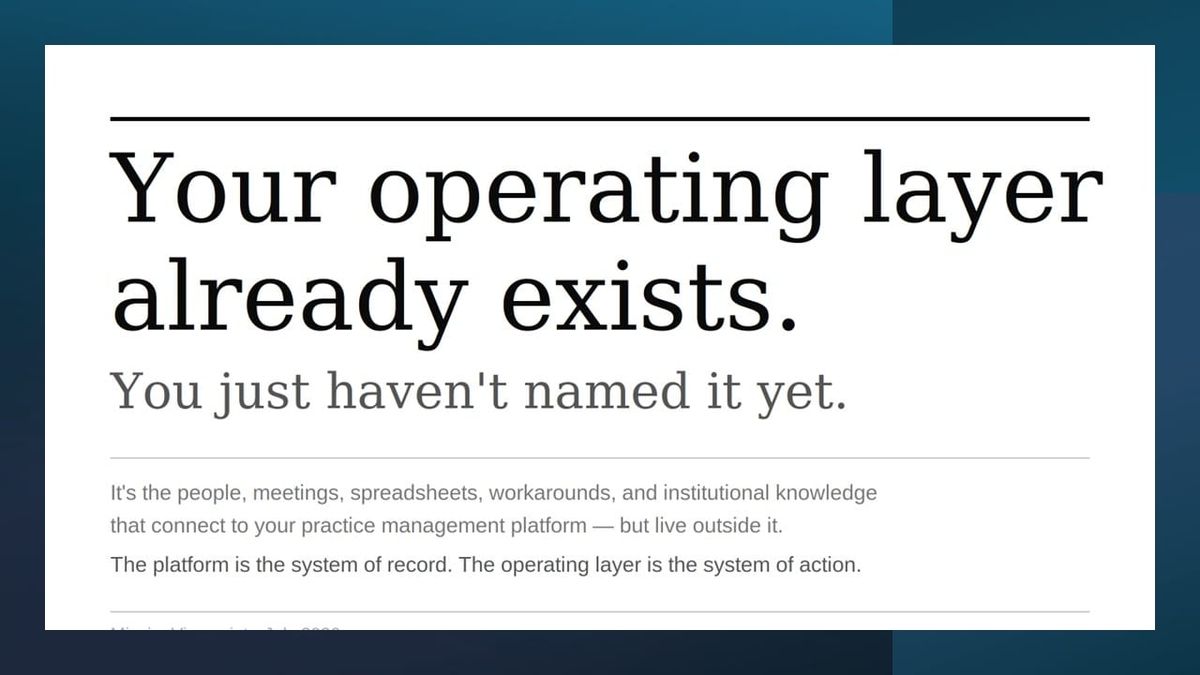
The platform is where records live. But a remarkable amount of the actual decision-making in most autism service organizations happens somewhere else entirely — in a spreadsheet a scheduler built two years ago, in a process a coordinator carries in her head, in a standing Wednesday meeting where clinical directors review caseloads using a report that someone exports, reformats, and emails every week.
This is not a failure of implementation. It's not a platform problem. It's a description of how complex service organizations actually function — and why understanding the difference between a system of record and a system of action matters more now than it did five years ago.
The Platform Did What It Was Designed to Do
It's worth being precise about what practice management systems were built to accomplish. They solved real problems at scale: coordinating scheduling across locations, managing billing and authorization workflows under regulatory scrutiny, tracking documentation and supervision at clinical standards.
The platforms that emerged to serve this market did exactly that, and they grew with the industry because what they offered was genuinely valuable.
But a system designed to record and coordinate is not the same as a system designed to drive operational decisions. The distinction is subtle until it isn't.
A practice management platform can tell you how many authorized hours a client has remaining. It cannot tell you — not reliably, not automatically — whether the client is trending toward underutilization because of a technician mismatch, or because the family's availability has shifted, or because cancellations have clustered in a way that's about to affect the authorization renewal. The authorization lives in the platform. The planning happens somewhere else.
That somewhere else is the operating layer.
Every provider has one. The question is whether they've noticed.
The Spreadsheet Is Not the Problem
When people hear "operating layer", they often imagine something highly technical — a shadow system, a parallel infrastructure, a sign that something went wrong.
In reality, most operating layers are remarkably ordinary.
A spreadsheet a scheduler maintains to track technician availability across sites. A weekly utilization report someone exports, reformats, and emails before Tuesday's clinical meeting. An authorization tracker built in a shared document because the platform's native view doesn't surface what the team actually needs to see. A collection of emails and notes that constitute the real documentation for how a process works.
None of these things are inherently bad. In fact, most of them exist because someone needed information to make a decision and built the simplest possible tool to get it. The spreadsheet isn't evidence of failure. It's evidence that somebody needed visibility that didn't exist somewhere else — and created it.
Organizations don't usually design an operating layer. They discover one. It emerges naturally as the business grows, as edge cases accumulate, as processes get refined through experience, and as the gap between what the platform was built to do and what the organization needs to know quietly widens.
Where the Outside Begins
The easiest way to identify the operating layer is to look for places where a decision requires information from more than one source — and where the platform alone can't close that gap.
Authorization management is the clearest example, and worth examining in detail.
The authorization itself lives in the platform. Remaining hours, approval dates, billing codes — that information is tracked, documented, and accessible. What the platform typically cannot tell you is whether that authorization is at risk.
- Whether the utilization pattern over the last six weeks suggests the family is pulling back.
- Whether the clinical trajectory supports the hours being requested at renewal.
- Whether the documentation is in shape for a potential audit.
- Whether the renewal deadline falls during a period when the assigned BCBA will be on leave.
Those questions require synthesizing information from the practice management platform, from the clinical team, from scheduling history, from the family's attendance record, and from organizational knowledge about how specific payors behave, and possibly from a separate software application.
In most organizations, that synthesis happens in a conversation, a spreadsheet, an email, a coordinator's head, but not in the practice management platform.
The same pattern appears across nearly every domain of operational complexity in ABA.
Technician-client matching is another example.
- The scheduling system surfaces availability.
- HR systems carry location and employment status.
- Clinical records contain treatment goals.
But the actual matching decision — the judgment about which technician is the right fit for this particular child, family, and clinical situation — emerges from a coordinator synthesizing all of that plus history, preference, supervision ratios, and institutional knowledge that doesn't exist in any single record. The data lives across platforms. The decision happens somewhere else.
Utilization monitoring follows the same logic. Most providers can report on delivered hours. Understanding whether a clinician's utilization reflects a structural problem, a temporary disruption, or a caseload that needs rebalancing requires layering scheduled hours against delivered hours against authorization headroom against cancellation patterns against the clinician's current capacity for new cases.
That analysis requires pulling from multiple places and applying judgment about what the combination means. The data points live in the platform. The operational picture lives outside it.
Revenue cycle exceptions work the same way. The claim lives in the platform. But the response to a denial — understanding whether it's a documentation issue, a payor behavior pattern, a credentialing gap, or a systemic workflow problem — requires analysis and pattern recognition that standard claim workflows weren't built to provide.
The skilled revenue cycle specialist who knows which exceptions are routine and which signal something systemic is doing work that happens outside the platform, even while working inside it.
The Knowledge Concentration Problem
There's a pattern that surfaces consistently in organizations that try to document their own operational processes: a disproportionate amount of how the business actually functions is concentrated in specific individuals.
This isn't unique to autism services. But it's particularly acute in ABA because the work is inherently complex, the workforce is often young and high-turnover, and the organizations that scaled quickly did so by promoting operationally talented people and letting them develop their own approaches. The result is organizations where critical institutional knowledge is embedded in people rather than in systems or documented processes.
This is manageable at a certain scale. It becomes fragile past it.
When the coordinator who manages matching leaves, the new hire doesn't inherit her logic — they inherit her job title and often have to reconstruct her approach from scratch.
When the clinical director who runs the weekly utilization review is on leave, that review either doesn't happen or happens less effectively.
When the revenue cycle specialist who knows which payors behave unpredictably moves on, the team loses the pattern recognition she had developed over three years.
The operating layer doesn't disappear when these individuals leave. But it degrades. And in organizations operating at volume — hundreds of clients, dozens of sites, thousands of sessions per month — degradation in the operating layer creates real operational consequences.
Scale Changes the Requirements
There's a particular dynamic that emerges as ABA organizations grow: the processes that worked at 50 clients create problems at 200 clients that don't become visible until 500 clients.
A scheduler coordinating staffing across 8 technicians and 40 clients can hold the matching logic in her head. The same logic applied to 30 technicians across multiple sites requires something more structured. A clinical director reviewing utilization for 60 clients in a weekly meeting can do it by feel. The same review across 250 clients in four service areas requires a process that doesn't depend on a single person's capacity and attention.
The informal operating layer that enabled growth often becomes the constraint on further growth. Organizations hit a ceiling not because their platform is insufficient, but because the operational logic surrounding the platform hasn't scaled with the business.
Many providers naturally attribute growth constraints to workforce supply, reimbursement pressure, or geographic expansion challenges.
Those factors are real. But operational complexity that outpaces organizational infrastructure can create constraints as well. In some organizations, the challenge is not demand or staffing alone. It's the growing difficulty of coordinating decisions that increasingly span people, systems, and processes.
The organizations feeling the most pressure right now are often not the ones that built poorly. They're the ones that built exactly what the market required — fast, at scale, under urgent demand. And now find themselves trying to run a more complex business on an operational foundation that was never designed to be examined.
Recognizing What You Already Have
One useful exercise for leadership teams is to ask a simple question: if our platform disappeared tomorrow, what would we rebuild first?
The answers are rarely limited to platform functionality. Leaders typically describe reports, workflows, exception processes, staffing logic, authorization monitoring routines, and communication patterns that exist around the platform rather than inside it. Those answers reveal the operating layer.
The goal isn't to eliminate it. Every organization needs one. The goal is to understand it — to make it visible, to make it transferable, and ultimately to make it less dependent on institutional knowledge that lives only in specific people.
Because the organizations that scale most effectively are rarely the ones with the fewest operational processes. They're the ones that understand those processes well enough to evolve them as conditions change.
That starts with recognizing something many providers overlook: you already have an operating layer. The authorization planning, the matching logic, the utilization review, the revenue cycle exception handling — it's already running.
The question is whether it's running in a way that scales, transfers, and remains visible as the organization grows.
What Comes Next
Recognizing the operating layer is not the same as fixing it. And fixing it doesn't mean replacing it. The knowledge and judgment embedded in experienced coordinators, clinical directors, and revenue cycle specialists is genuinely valuable.
The challenge is that operational decisions rarely depend on information from a single place. As organizations grow, the ability to move information between systems, teams, and workflows becomes just as important as the information itself.
Most providers already have the operational logic they need. What they often lack is a consistent way to connect the information that logic depends on.
That's where the next phase of operational infrastructure begins.
This is the first in a three-part series around this month's theme of "The Rise of the Operating Layer."
Next in the series: Why Every Provider Needs a Data Spine — and how information moves from systems of record into systems of action.
P.S. Know someone shaping ABA operations, technology, or investment? Invite them to subscribe at missionviewpoint.com.


