Operator Spotlight on Lighthouse Autism Center: Scaling Diagnostic Capacity Without Compromising Rigor
Lighthouse Autism Center operates at a scale where clinical decisions become operational systems.
As a multi-state ABA provider serving families across the Midwest, its diagnostic workflows cannot rely on individual heroics. They must be repeatable, defensible, and consistent across locations.
When Dr. Steph Luallin joined Lighthouse four years ago, there was no diagnostic program.
She built it.
Today, as Senior Director of Diagnostic Operations, she oversees a growing evaluation service line in an environment where demand is rising, psychologists are scarce, and payor documentation requirements continue to evolve.
The constraint wasn't ambition.
It was capacity.
The Bottleneck: Over-Reliance on Doctoral-Level Clinicians
Steph's path to Lighthouse was anything but linear. She completed her doctoral training at the University of Northern Colorado, worked at Denver Children's Hospital's neuropsychiatric specialty unit — where children with autism required inpatient care — then moved through residential care at Devereux in Pennsylvania and a fellowship at Riley Hospital for Children in Indianapolis. When Lighthouse was building its first diagnostic program, she was the first psychologist they ever hired.
She was also, at that time, effectively, the entire diagnostic function.
Four years later, the structural reality hasn't changed as much as the demand has.
"I've been trying to hire psychologists for almost a year. It's really hard to find them."
Diagnostic capacity in autism care is still anchored to doctoral-level clinicians. In many markets, supply does not meet demand — particularly for younger children, where earlier diagnosis can significantly influence developmental trajectories. Steph has expanded her team and continues to recruit. But hiring alone doesn't close the gap.
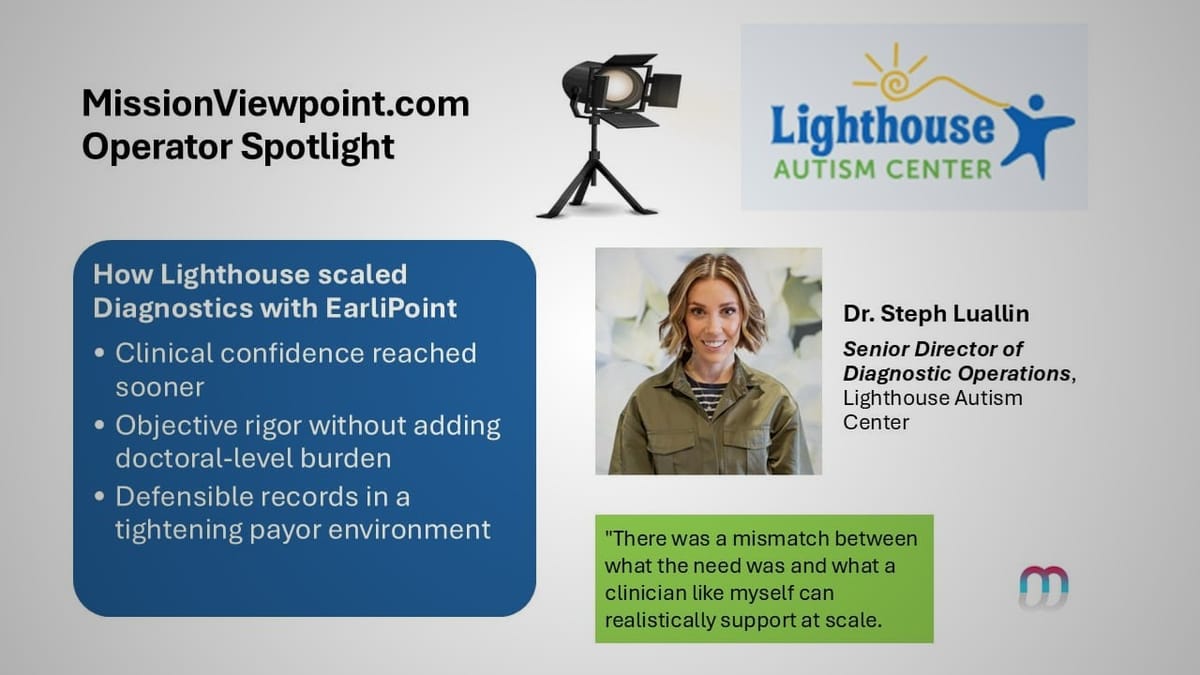
"There was a mismatch between what the need was and what a clinician like myself can realistically support at scale."
Scaling requires more than hiring.
Adding Objectivity Without Adding Burden
Autism evaluations typically include developmental interviews, parent-completed screeners, direct observation, and standardized tools such as the ADOS-2. All are valuable. All require training and experience.
But they are fundamentally interpretive.
"When I don't have an objective measure, it's all subjective. I have parents' report of their child's development — and that can vary depending on experience and context. We have screeners completed by parents. We have my observation. We have the ADOS-2. All rooted in strong clinical expertise. Brilliant, but inherently interpretive."
At scale, under workforce constraints and payor scrutiny, that subjectivity introduces variability — and internal hesitation. Steph was looking for a way to add rigor without adding more to her plate or requiring another doctoral-level clinician to execute.
She found it at a lunchtime presentation she almost skipped.
The Marcus Autism Center was hosting a session on an FDA-cleared eye-tracking technology that measures patterns of social visual engagement as part of autism assessment. Steph had questions. Follow-up conversations followed. And she reached a conclusion that was, for her, immediate and practical.
The platform — EarliPoint — became the foundation for how Lighthouse began integrating objective data into its diagnostic workflow. Importantly, it functions as one component of a broader, multi-method evaluation—not a standalone diagnostic tool.
"It doesn't require a doctoral-level clinician to administer."
That single operational fact changed the calculus. A non-doctoral clinician could run the assessment, and the results fed into Steph's evaluation as an additional, objective data point — without adding to her own workload or requiring another hire she couldn't make.
The operational impact was measurable.
"On average, I'm saving about 20 minutes per family."
Steph sees roughly 70 children per month. Twenty minutes per child — at doctoral-level expertise — compounds quickly.
But the more meaningful impact was not time alone.
Clinical Confidence, Sooner
"It has allowed me to have clinical confidence sooner."
By the time Steph completes a developmental interview and clinical observation, she typically has a strong sense of the diagnostic direction. When the objective data aligns with that clinical read, it reinforces the decision and allows her to move forward — more quickly, and with less internal friction.
"By the time I’ve completed the developmental interview and observation, I typically have a strong sense of the diagnostic direction. When it aligns with that, it reinforces the decision and allows me to move forward with greater confidence."
That shift — from subjective confidence to reinforced confidence — is the real throughput gain. Not the 20 minutes alone. The decisional clarity that follows from having objective data in hand changes how a clinician moves through her caseload.
And for families, the change registered differently than Steph expected.
The ADOS-2 is play-based by design. For clinicians, that's a feature. For families watching from across the room, it can feel like the absence of rigor — a psychologist who just played with their child rather than tested them. Adding a technology-driven component shifted that perception.
Steph heard from two families — unsolicited — who had an older child go through the traditional process, then a younger sibling go through the updated one. Both said they preferred the newer approach.
"I think they loved it because they could see that an actual test had been administered. There is data they couldn't even see with the human eye. That really resonates with families."
Operating in a Tightening Payor Environment
The trust that matters most operationally, right now, isn't with families.
It's with payors.
In Indiana, where Medicaid documentation standards have recently tightened, diagnostic reports are scrutinized closely. Peer-to-peer reviews and shifting authorization criteria are part of the daily operating reality. Steph is direct about what that costs.
"There's a lot of my time recently — I'm talking three hours of every single day — focused on peer-to-peers, making amendments, changing my template to be sure we're in compliance with what they're asking. Which, by the way, changes constantly."
Three hours a day is not a rounding error. It is clinical capacity that isn't being used clinically.
In that environment, defensibility matters. Objective visual engagement data strengthens the clinical record — not by replacing the developmental interview or standardized testing, but by providing an additional evidence layer that complements them. For Steph, that reinforcement improves her ability to stand behind a diagnosis under scrutiny.
"We've seen strong acceptance rates so far. I'm advocating hard for this kind of objective data to be recognized as a genuinely accepted part of the evaluation — not just a supplement."
Accuracy, Rigor, and Limits
Steph is careful not to overstate.
When the objective measure indicates autism, it has consistently aligned with her clinical assessment. More nuanced presentations — particularly children with stronger social engagement at what she calls the "level one" end of the spectrum — can require additional clinical interpretation. False negatives occur in those cases.
"I would much rather there be false negatives than false positives. That reflects the conservative and rigorous nature of the measure. It doesn't want to say a child's looking behaviors are consistent with autism when that may actually be a strength for that learner."
The tool is an input. Clinical judgment remains the output.
What Comes Next
The age range for EarliPoint's kind of objective assessment is expanding — now reaching children up to age 8, compared to the original window of 16 to 30 months.
For Lighthouse, that matters less as a product milestone and more as an operational one. ABA requires frequent reassessment. Children diagnosed at 18 months are now in school. Treatment intensity shifts. Authorization justifications evolve. A wider age range means the diagnostic layer can stay engaged across more of a child's treatment arc — not just at the front door.
Steph is also watching for something harder to measure: whether objective social engagement data, tracked over time, can show that the work happening in the center is generalizing to the community.
"A big goal in ABA is to increase what a child is paying attention to so that their attention is directed toward things that matter. If we can show that over time, that would be fantastic."
That question doesn't have an answer yet. But Lighthouse is positioned to pursue it.
The Broader Signal
This story is not fundamentally about a specific technology.
It is about structural constraints in autism diagnostics — and what a pragmatic response looks like when it's built by someone who has spent her entire career inside the clinical reality of this work.
This was never about finding a shortcut. Steph came looking for a way to preserve rigor at a scale that her own expertise, alone, couldn't sustain.
In the broader autism operating model, diagnostics sit at the very top of the stack. If the front door is inconsistent, everything downstream — scheduling, staffing, authorizations, treatment intensity, outcomes reporting — absorbs that variability.
Steph has spent four years strengthening that front door.
The work isn't finished. But the model is real.