Operator Spotlight: Wild Sun Behavioral Services - Preserving a Human Centered Care Model
Wild Sun Behavioral Services was never designed to scale aggressively.
When founder Daniel Kurty first opened the practice in Colorado, the plan was intentionally modest: stay close to the work, deliver care thoughtfully, and avoid becoming the kind of organization he had struggled within earlier in his career.
“I was just going to do everything myself,” Daniel told me. “And then I blinked — and we had a staff of 25.”
That moment captures much of Wild Sun’s story. Growth didn’t arrive through strategy decks or acquisition plans. It arrived through demand, via a care model that resonated with families and clinicians .
The challenge, as it so often is in ABA, wasn’t whether the clinical mission worked.
It was whether the business could survive the operational and financial strain that came with it.
A Practice Built on Relationship, Not Reinforcement Gadgets
Wild Sun’s differentiation starts with a philosophy Daniel returns to repeatedly: relationship is the primary reinforcement.
While ABA is often criticized as overly mechanistic or data-obsessed, Daniel is quick to point out that this reputation has more to do with how ABA is implemented than the science itself. At Wild Sun, data supports care. Connection still comes first.
That humanistic posture extends to staffing as well. Many of Wild Sun’s BCBAs began their careers as technicians within the organization, growing into clinical leadership roles over time. In a field defined by turnover, Wild Sun has built a culture where people stay — even if it means operating with very little margin for error.
“We’re not lucrative,” Daniel said plainly. “We live pretty close to the edge. But we pay our people as much as we can, because that’s who we are.”
That choice, however, leaves no room for operational chaos.
When Billing Stress Becomes Existential
For Wild Sun, the breaking point wasn’t clinical complexity.
It was billing unpredictability.
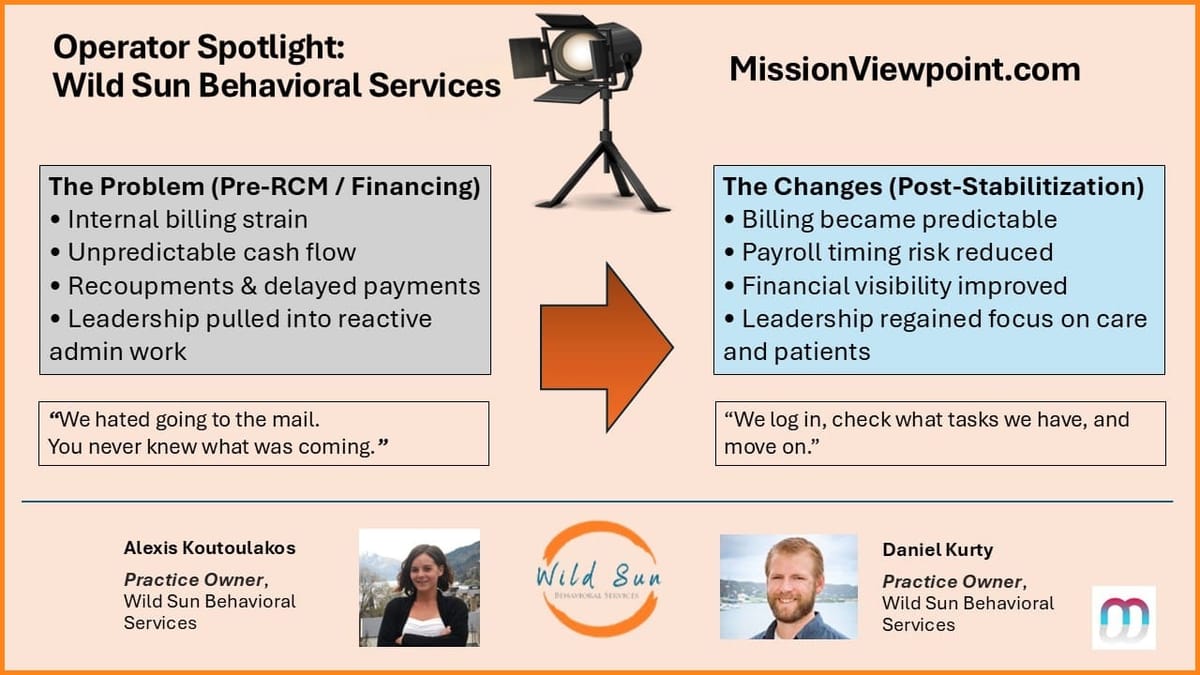
Like many small providers, the team initially tried to manage billing internally. What followed was a familiar pattern: denials, recoupment letters, corrected claims, and months-long delays that made cash flow nearly impossible to forecast.
“We hated going to the mail,” Daniel said.
“You never knew what was coming — an overpayment notice, a denial, something you missed six months ago.”
The stress wasn’t just financial. It was emotional. Leadership attention was constantly pulled away from care, staff development, and long-term thinking — replaced by reactive administrative work.
To regain control of their revenue cycle, Wild Sun adopted tools that made billing more visible, preventative, and actionable — including working with Camber as their billing partner.
From Reactive Billing to Predictable Operations
By changing how billing issues surfaced, Wild Sun shifted from reacting to problems after the fact to addressing them earlier in the process.
Instead of learning about errors only after claims were denied, potential issues became clearer upfront. Tasks were explicit. Fixes happened before submission. Over time, the steady drumbeat of payer correspondence faded into the background.
“We don’t really get things in the mail anymore,” Daniel explained.
“We log in, check what tasks we have, and move on.”
Just as important, billing became predictable. Knowing when claims were going out — and roughly when payments would arrive — gave Wild Sun something it hadn’t had before: operational confidence.
That predictability opened the door to the next layer of work.
Managing the Gap Between Payroll and Reimbursement
Even with cleaner billing, one reality remained: payroll timing and reimbursement timing rarely align in ABA.
To reduce the stress and risk created by that gap, Wild Sun used claim-based financing through Flychain. The goal wasn’t growth capital or expansion — it was stability.
That financing allowed the team to make payroll when reimbursements lagged, without relying on expensive credit or operating in constant crisis mode.
Scaling faster wasn’t the point. Being able to sleep at night was.
“Without these platforms,” Daniel reflected, “we wouldn’t have had the capacity to keep operating the way we wanted to. Something would have had to give.”
The financing acted as a pressure-release valve while Wild Sun’s billing processes stabilized — giving leadership the breathing room to stay focused on care rather than survival.
Financial Clarity as a Leadership Tool
As operations became steadier, Wild Sun’s needs shifted from short-term risk management to longer-term visibility.
Historically, the organization relied on bookkeeping tools that felt disconnected from day-to-day decision-making — software that existed largely to support tax filing rather than active management.
With clearer books and better visibility into expenses and incoming revenue, Wild Sun could finally use financial data as a leadership tool. Flychain’s bookkeeping platform supported that shift by making the numbers easier to understand and act on.
That clarity allowed the team to ask better questions — not just Are we getting by? but Are the programs we’re building sustainable?
Over time, as predictability improved, reliance on short-term financing decreased. What remained was a clearer sense of what was actually happening inside the business.
Staying Small on Purpose — and Making That Possible
Despite consistent demand, Wild Sun has resisted the pull toward franchising or aggressive expansion. The reason isn’t lack of ambition — it’s protection of integrity.
“There are times where growth makes you feel like you lose control of how you’re represented in the community,” Daniel said.
“That doesn’t feel good to us.”
Instead, Wild Sun has chosen to stay local, flexible, and deeply connected to the families it serves — even as that choice makes the business harder to run.
Ironically, it is operational support — not scale — that has made this restraint possible.
Creating Room for What Comes Next
Perhaps the most telling outcome of Wild Sun’s operational evolution isn’t efficiency or margin.
It’s focus and capacity.
With less administrative stress and more financial clarity, the team has begun laying the groundwork for a broader educational initiative — a nonprofit learning environment designed to support children who aren’t well served by traditional systems.
The idea is still taking shape. The intent, however, is clear — and deeply consistent with Wild Sun’s origins.
This isn’t a story about software swooping in to save a practice.
It’s a story about how reducing operational chaos allows mission-driven providers to keep showing up — for their staff, their families, and, ultimately, for access to care itself.
Why This Matters
Wild Sun’s experience highlights a quieter truth in ABA:
The difference between scaling responsibly and burning out isn’t always clinical sophistication. More often, it’s whether the systems behind the scenes allow operators to breathe.
For Wild Sun, technology didn’t change who they are.
It simply gave them the room to keep being it.