The Head Chef Leaves the Kitchen
CentralReach's CEO is stepping down. The financials say the company is fine. The question I raised last October just got harder to avoid.
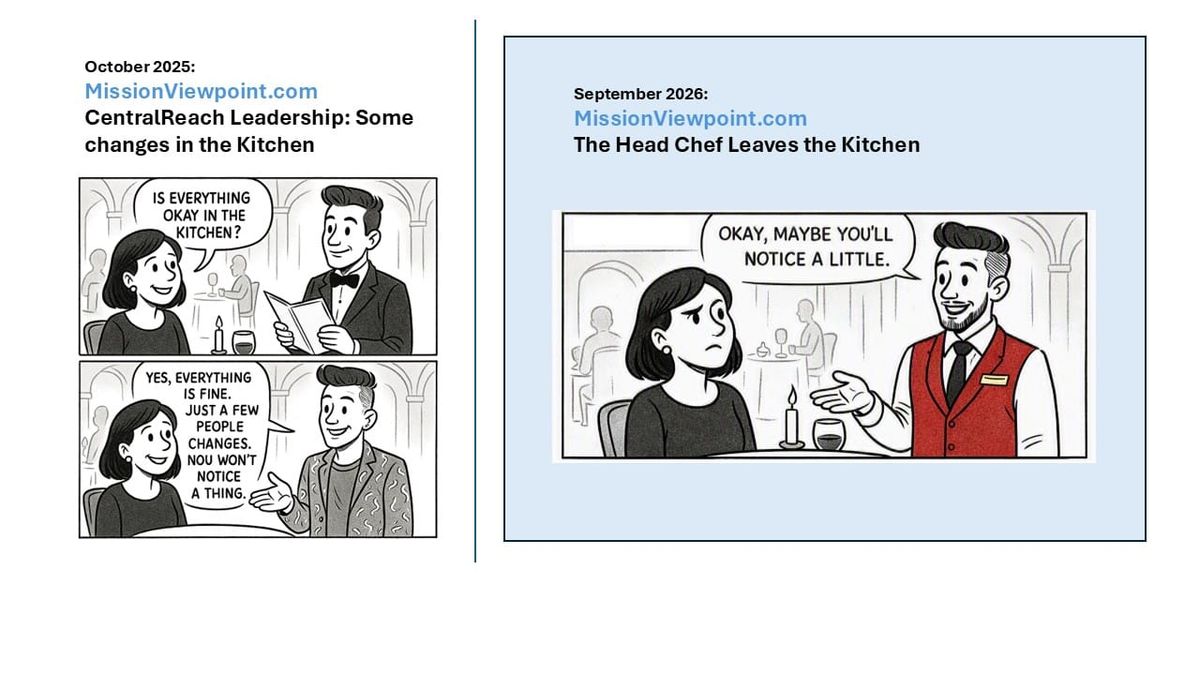
Last October, after CR Unite, I wrote that watching CentralReach was like asking the maître d' if everything was okay in the kitchen. The answer is always yes.
Three senior leaders had just moved on months after the Roper acquisition closed, and I argued that the open question wasn't operational stability. It was strategic alignment — and whether CentralReach still had a clear story about how it wanted to serve its largest customers.
The staff kept changing mid-course.
Now the head chef has left the kitchen.
Chris Sullens is stepping down as CEO after eight years. CentralReach's own CR Unite agenda now bills him as Former CEO and Strategic Advisor and lists Chief Operating Officer Clark Convery as Interim CEO. A permanent search is the obvious next step, though the company hasn't put a timeline on it.
This isn't a rescue
The first thing to say clearly, because the instinct on a CEO exit is to assume trouble: the numbers don't describe a company in trouble.
Roper's Q2 investor materials reported that CentralReach hit its year-one revenue and EBITDA targets. Roper's Application Software segment posted strong margins, and the company raised full-year guidance at the same meeting.
When Roper bought CentralReach for roughly $1.85 billion gross in April 2025, it told the market to expect about $175 million of revenue and $75 million of EBITDA in the first twelve months, with organic growth above 20 percent. Nothing Roper has published since points to a business missing its plan.
So whatever prompted this transition, the public record points to strength rather than weakness.
That makes it more interesting, not less.
A CEO leaving a struggling company is a story that explains itself. A CEO leaving one that just hit its targets, sixteen months into new ownership, raises a different question: what comes next?
What sixteen months means
Leadership turnover after an acquisition is not unusual, and Roper's decentralized model — which leaves portfolio companies to run themselves and rewards accountability over integration — makes this kind of internal handoff unsurprising.
I made that same point last October, and I'll hold to it now: this looks like a conventional transition drawn from the operating bench, not Roper seizing the wheel.
But sixteen months is still short for a company that told customers, at the time of the deal, that nothing would change — same leadership, same team, same mission. The leadership portion of that promise has now turned over substantially in under two years, up to and including the chief executive.
That's not a scandal. It is a useful reminder of how much continuity a provider running its entire operation on one platform should actually assume.
More importantly, it brings me back to the question I left CR Unite with last year.
My concern then wasn't that CentralReach was unstable. It was that the company's outward focus felt less defined — that CR Unite's content skewed toward the middle of the customer base and left enterprise providers with fewer signals about the long-term data, integration, and platform roadmap.
A year later, that question hasn't gone away (at least in my mind).
Execution isn't the question
It's worth holding that concern in balance because parts of the product story are clearly working.
CentralReach's AI features around billing and clinical notes — including claims auditing and note drafting — appear to be landing well with customers, and they're aimed directly at documentation and reimbursement problems providers are dealing with now.
That's real value, and it matters.
The question I'm asking sits a level above individual features: what role does CentralReach ultimately want to play in the operating architecture of its largest customers?
Is it primarily the increasingly capable system of record at the center of the stack? Does it intend to own more of the surrounding workflows? How open does that stack become to specialized applications, data warehouses, AI, and other systems that enterprise providers increasingly want to operate around it?
And how does CentralReach translate the strategic bets it has already made into that larger story?
Last August, for example, when CentralReach acquired SpectrumAi and AI.Measures, I wrote that the combination looked like a serious attempt to build infrastructure for outcomes-based ABA. A year later, I don't think there's enough visible evidence yet to say how that bet is playing out.
That's not necessarily surprising given the ambition of what CentralReach set out to do. But it belongs on the list of strategic questions a permanent CEO will inherit.
The issue isn't whether CentralReach can ship useful products. It clearly can.
It's whether all of those pieces add up to a direction customers — particularly the largest ones — can see.
On Clark Convery
I should disclose that I've worked with Clark Convery directly.
Years ago he helped me stand up the first technology partnership CentralReach built out with an outside operator, and when I was on the provider side dealing with data-warehouse issues, he was the person who made sure I got real engineering attention rather than a ticket number.
My read on him is firsthand: he's a straight shooter and a capable operator, and the day-to-day business is in steady hands under him.
That's the reassuring part, and it's genuine.
But it should be bounded honestly. Convery running customer operations, sales, and the company's billing service well is exactly why he's a logical person to keep the trains running through a transition.
The unanswered question is whether he's maintaining the existing direction while a search runs or is ultimately the person the board wants setting that direction himself.
Steady is real. The permanent mandate is still unknown.
The timing, and what it isn't
The Sullens news went out the same day Hi Rasmus announced a $50 million minority investment from Updata Partners — its first outside capital, earmarked explicitly for enterprise capabilities.
To be clear, I think these are unrelated. A leadership transition at a Roper company has its own internal logic, and I wouldn't read one into the other.
But landing on the same day, they sharpen a contrast worth naming.
At the enterprise end of the ABA technology market, the incumbent has entered a leadership transition while a challenger has just raised significant capital specifically to press upmarket.
A leadership transition at the incumbent is precisely the moment a newly capitalized challenger has room to make its case. Enterprise buyers make long-duration platform decisions, and clarity about where a vendor is headed matters alongside what the product can do today.
That's not a prediction that Hi Rasmus takes share.
It's an observation that the opening is wider today than it was on Wednesday.
What it means depending on where you sit
For customers and partners: Day-to-day continuity appears solid, product execution is holding, and Convery is a known quantity running a deep operating team. The open question sits above the feature level: what CentralReach's enterprise, data, integration, and broader platform strategy looks like under its next permanent leader. If your practice runs on this platform, this is also a good reminder to have a continuity plan you can actually execute, not one you assume you'll never need.
For competitors: Don't mistake a CEO search for a company falling apart. The financial and operating evidence doesn't support that story. The credible opening is around strategic clarity at the enterprise tier, not operational chaos.
For investors: The financials support a story of strength, so I would read this as a strategic transition rather than a distressed one. What matters next isn't whether CentralReach keeps operating. It's what mandate the board gives the person selected to lead it.
CR Unite becomes the forcing event
That makes this year's CR Unite unusually interesting.
The agenda now lists the September 22 keynote as a shared slot: Sullens, billed as Former CEO and Strategic Advisor, on stage alongside Convery as COO and Interim CEO.
That's a deliberate choice.
The outgoing chief executive isn't being quietly removed from the program. CentralReach is putting both leaders on stage together in front of its customers, effectively staging the transition as a handoff rather than a rupture.
In one sense, it's the most visible way the company can answer the old "is everything okay in the kitchen?" question.
But the conference also becomes the first occasion on which thousands of customers can listen for something beyond reassurance.
Last year's CR Unite raised the question for me. This year's has an opportunity to answer it.
The product announcements will matter. So will the AI roadmap. But I'll be listening most closely for the connective tissue: how CentralReach describes the role it intends to occupy for providers, particularly its largest ones; how it talks about integrations and data; and whether the pieces of the expanding platform add up to a coherent strategic direction.
I've attended the last two CR Unites and would particularly like to be in the room for this one. Unfortunately, it lands in the middle of a camping trip in Iceland, so I'll be comparing notes with those who make it to Boston.
The one thing to watch
CR Unite can tell us how CentralReach explains the transition.
The permanent CEO selection will tell us considerably more.
Don't just watch who gets the job. Watch what that person's background tells you about what Roper and the CentralReach board believe the company needs next.
An internal operating leader would suggest an emphasis on continuity, execution, and extracting more growth from the platform CentralReach has already built. An external platform executive could signal a different ambition. Someone steeped in clinical outcomes, healthcare data, or value-based care would send another signal entirely.
None of those choices is inherently better. They're different answers to the same question.
And that's why I keep coming back to what I wrote after CR Unite last year.
CentralReach didn't look unstable then. It doesn't look unstable now.
What wasn't entirely clear was where the company wanted to go next.
The CEO search may finally give us the answer.
Like a restaurant where the staff changes mid-course, diners notice who's now in the kitchen.
This time, the choice of head chef may tell us what's going to be on the menu.
I track both sides of the ABA technology market — platforms and providers — at MissionViewpoint. Subscribe for the ongoing coverage.