MissionViewpoint Monthly Update — September 2026
This Month’s Theme
Building Organizational Intelligence
“We’re using AI” has stopped meaning anything useful.
This month’s three-part series works through the question that actually separates providers: not whether they use AI, but how much of the operation they’ve actually put within its reach.
The answer runs from your tech stack, to a loop you can run by hand this month, to what your organization can’t take with it when the technology changes.
“Capability isn’t a feature you switch on. It’s a loop you run.”
And the SCUBA data kept doing what it’s done all year. It signals a more resilient story than the industry’s conversation about ABA market health.
Let’s get into it.
You’re Using AI. That’s Not the Same as Building It.
Ask a provider if they’re using AI and the answer is increasingly yes — notes, scheduling, revenue cycle, recruiting. All genuinely useful.
But the real distinction isn’t between using AI and building it. Most providers shouldn’t build their own AI technology. It’s between having software that uses AI and having organizational AI capability.
Every application inherits a boundary. A scheduling system knows the schedule; an authorization tool knows authorizations. AI makes each better at its own job. But the questions that run an organization don’t respect software boundaries.
Which authorization puts the most delivered care at risk? Why is one region at 78% utilization and another at 91%?
Those answers live across the operation, and making every individual application smarter doesn’t make the organization smarter. AI can’t reason across context it doesn’t have. Often, your tech stack becomes an intelligence ceiling.
Read →Point AI at Your Operation, Not Your Software.
The obvious objection to Part One: building sounds like engineers, integrations, a year of work and a budget I don’t have. It doesn’t have to.
The smallest thing that counts as building is a loop you can run by hand this month. Export a few reports, reason across them with AI, put the result in front of an operator who knows the operation, capture what they know that the reports didn’t, change one thing, and watch what happens.
This is an operations initiative, not an IT one. Get the environment right before any PHI moves. Then reason across the reports instead of summarizing each. And when the operator disagrees with the analysis, keep the disagreement — the overrides are the material.
The manual loop doesn’t scale, and that’s the point: it tells you precisely what a durable version needs to fix.
Read →Whose Data Does Artificial Intelligence Compound On?
Run the loop a thousand times and something accumulates — not inside the model, around it. Which raises the question the whole series was working toward: where does that learning live?
Data portability asks whether you can take your records with you. Intelligence portability asks whether you can take what your organization learned with you.
Even if the records migrate, the judgment may not. Some intelligence compounds better at the vendor level — claim-behavior patterns across hundreds of customers no single provider could discover alone.
Some is specific to your operating model and compounds with you.

As AI embeds in operating workflows, a new switching cost appears alongside migration and retraining: the cost of relearning.
The test isn’t whether every artifact can technically be exported. It’s simpler — if this technology disappeared tomorrow, what would we have to relearn?
Those are the things worth making durable.
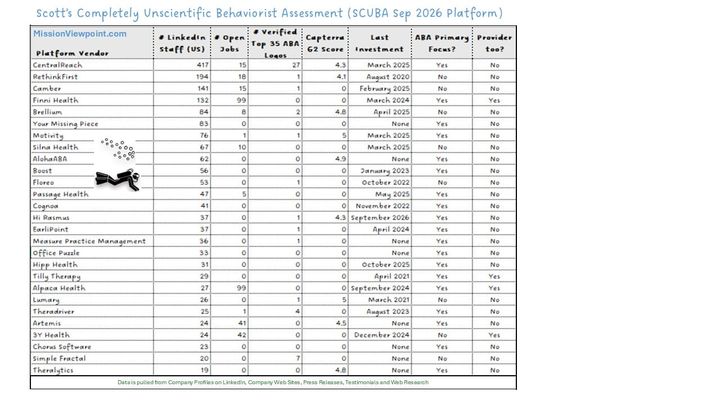
Read →🤿 SCUBA — Scott’s Completely Unscientific Behaviorist Assessment of where providers and platforms stand each month.
It isn’t just the Top 20 anymore.
For months the resilience story could be explained away as large providers taking share. So this month I looked further down.
Across 134 mid-sized providers, aggregate LinkedIn headcount rose 6.7% over six months — and roughly 80% (107 of 134) grew.
Growth remained strong among providers in the 100–499 employee band, and the Q2 MVP Cohort added 12.9% collectively.
When four of five mid-sized providers are still staffing up, the disconnect between the caution in the room and the data on the page gets much harder to dismiss.
Read the full Provider SCUBA →Integration starts showing up in operating workflows.
Two developments this month made the integration story more concrete. Motivity and Frontera Health launched their assessment integration — specialized AI connecting to the core platform rather than being rebuilt inside it.
Hi Rasmus and Lumary reported their combined deployment now supports 7,300+ clients and 3,100+ employees, a real test of whether a connected-platform model holds at provider scale.
And since I published SCUBA, Hi Rasmus raised $50 million from Updata Partners after reaching more than 1,000 organizations without institutional capital — giving that connected-platform strategy considerably more resources behind it
The question is shifting from whether platforms will interconnect to whether those connections actually work once they hit real workflows.
Read the full Platform SCUBA →Closing Thoughts
Three articles, one subject: “Building Organizational Intelligence”
They looked like a series about AI. They were really about organizational memory — what a provider keeps when the model, the vendor, or the platform changes underneath it.
Models will keep improving and AI will spread through every software category providers touch, which means simply having AI will stop being distinctive.
The strategic asset isn’t the model or the data alone. It’s the ability to turn operating experience into reusable knowledge and carry it forward as employees, applications, vendors, and models change.
That’s what it means to build organizational intelligence — not building the model, but building an organization that doesn’t have to keep relearning what it already knows.
Until next time,
— Scott
P.S. I work with ABA providers, platforms, and investors on strategy, operations, and market positioning. If that’s relevant to your work, just reply to this email.
Upcoming Theme for next Month's Newsletter
The Unbundling of Work
For twenty years the practice management platform tried to own the record and the workflows around it. That bundle is starting to come apart.
Specialized companies can now take responsibility for work that once lived inside the platform or inside a provider's own labor force. AI pushes the boundary further: increasingly, a capability can reason across the record without being the system that owns it.
We’ll work through three questions:
What happens when a piece of that work becomes a capability you can simply buy — delivered through some mix of software, AI, and people?
Just because a capability can be unbundled, should it be — or is it strategic enough to pull inside and even build yourself?
And how should a provider architect for all of it at once — a strong core for the commodity work, with room to plug in specialized capability, or bring work back in, where it actually earns its place?
Plus an Operator Spotlight: how AB Spectrum built its stack by starting with the operating model instead of the software.