September 2026 Platform SCUBA Update
Theme: Platform strategies begin to diverge
Over the past several months, Platform SCUBA has tracked vendors becoming more deliberate about what they build, what they integrate, and where they believe they can differentiate.
September made those choices more visible.
New capital is being directed toward enterprise scale rather than acquisition. Specialized products are extending broader platforms without replacing them. Migration and implementation are becoming competitive capabilities. And the market's largest platform is entering a new leadership era.
Rather than converging toward a single model, platforms appear to be making clearer choices about what they own, what they integrate, and where they compete.
📉 Market Signals & Hiring Trends
Platform hiring remains active but concentrated.
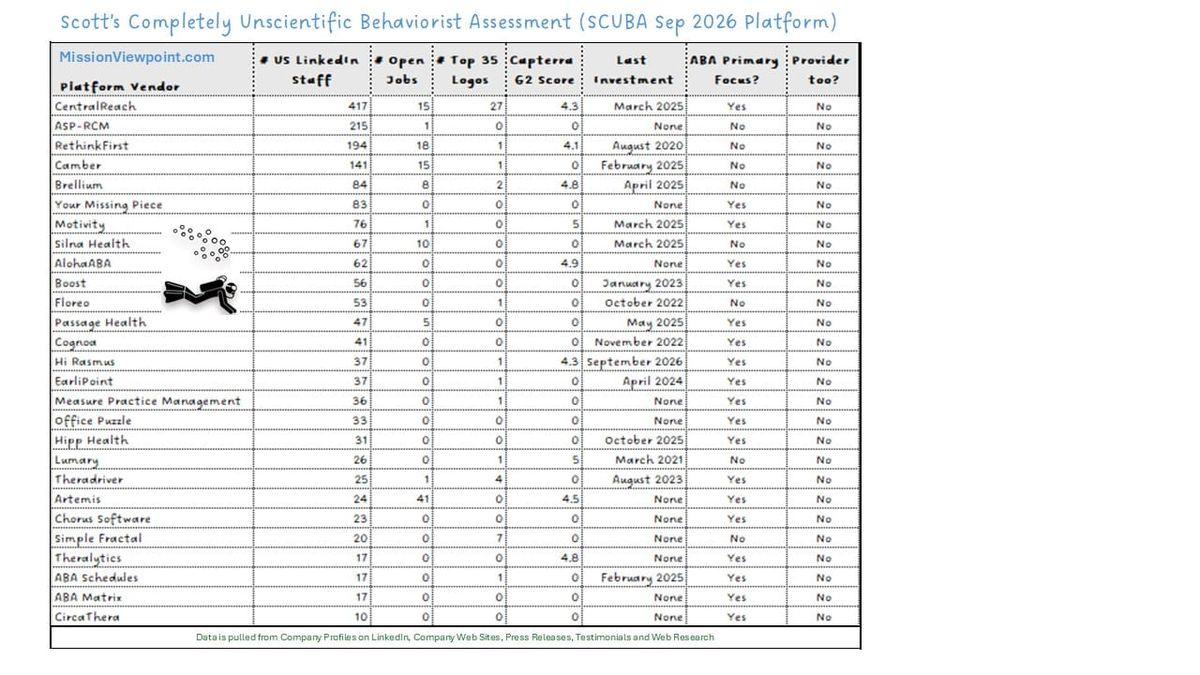
Across the companies tracked this month, there are more than 130 publicly listed open positions. But most of that activity is concentrated among a relatively small group of companies, while roughly half of the tracked platforms currently show no open roles.
The broader signal remains consistent with recent months: the platform market is not broadly retrenching, but investment in additional staff is uneven. Some companies continue hiring aggressively while much of the market operates with comparatively lean teams.
As always, LinkedIn headcount and job postings are directional rather than precise measures.
🔎 Notable signals from September
- Hi Rasmus raised a $50 million minority investment from Updata Partners. The company says the capital will support infrastructure, AI, enterprise implementation, and outcomes research while telling Behavioral Health Business that additional fundraising and M&A are not currently planned. That points, at least for now, toward scaling its clinical-first model rather than acquiring its way into a broader suite.
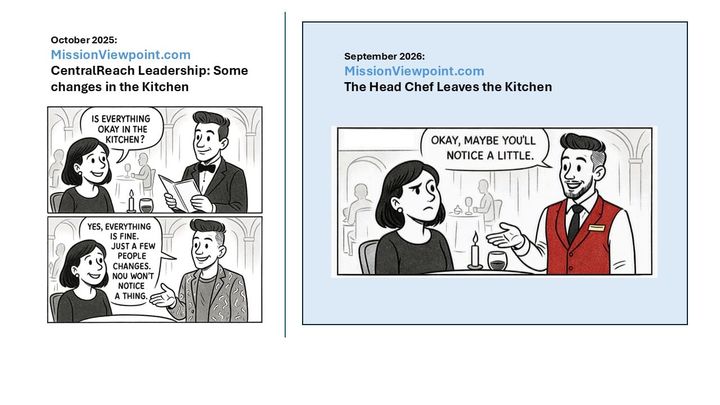
- CentralReach CEO Chris Sullens stepped down after eight years, with COO Clark Convery becoming Interim CEO. The transition comes roughly 17 months after Roper Technologies' $1.85 billion acquisition and shortly after Roper reported that CentralReach achieved its year-one revenue and EBITDA targets. The market leader now enters its first major leadership transition of the post-acquisition era.
- Motivity and Brellium announced an integration that automatically reviews Motivity session notes for documentation gaps, funder requirements, and billing risk. It is another example of a platform extending its operating workflow through specialized technology rather than reproducing the capability internally.
- Theralytics began promoting free, fully managed end-to-end data migration, with a dedicated team handling extraction, mapping, and auditing. Details about supported data and source systems remain limited publicly, but the competitive signal is clear: migration is increasingly becoming part of the product rather than a switching problem left to the provider.
- ABA Schedules and Lumary announced an integration that keeps Lumary at the center of the operating environment while using ABA Schedules for schedule optimization without recreating data. It illustrates another version of the connected-stack model: a specialized product can extend the system of record without attempting to replace it.
🔀 Different Paths Forward
September's signals don't point toward a single definition of what an ABA platform should become.
Some vendors are investing in the scale required to support larger organizations. Others are connecting specialized products around a core operating platform. And as providers gain more choices, implementation and migration are becoming part of the competitive equation as well.
That creates a meaningful alternative to simply building an ever-larger feature set inside a single product.
It doesn't mean the all-in-one model is disappearing. In fact, some vendors continue to argue that keeping scheduling, credentialing, billing, and other workflows inside a common system reduces the operational problems created by fragmentation.
But the strategic choices are becoming clearer.
The next phase of ABA platform competition may be less about matching feature lists and more about which capabilities a platform chooses to own, which it connects to, and how easily providers can assemble—or change—their operating stack.
🧪 SCUBA Dataset Refreshed
This month's update continues to track:
- U.S. LinkedIn headcount
- Job postings
- Top-35 provider traction
- Investment history
- ABA market focus
- Public rating signals
SCUBA stands for Scott's Completely Unscientific Behaviorist Assessment.
It is a recurring, dataset-backed snapshot of activity across the autism services ecosystem—not a market-share study or scientific ranking. The goal is to combine imperfect but observable signals to better understand how the infrastructure supporting ABA care is evolving.
If this analysis is useful, you can subscribe to receive future SCUBA updates and related insights through the MissionViewpoint newsletter.
Feedback is always welcome. I appreciate corrections, clarifications, and additional data points from operators, vendors, and investors.