Operator Spotlight: How Akoya Built a People-First Operating Model From Day One
A workforce-centric philosophy that shaped their systems, their culture, and their scale
Most ABA organizations modernize HR only after something breaks.
Payroll headaches accumulate, onboarding becomes chaotic, or turnover exposes cracks that were always there.
Only then does the organization look for better systems.
Akoya Behavioral Health flipped that sequence.
They began with a belief: workforce stability is a clinical outcome, and the staff experience must be designed with the same intention and rigor as client care.
Before opening multiple sites, before expanding into new markets, and before operational complexity caught up with them, Akoya built the infrastructure to support people consistently. And it shows.
This Spotlight focuses on that operator mindset — and how their approach to systems reflects a deeper philosophy, not just a software decision.
A Philosophy That Starts With People
Akoya’s CEO, Yitz Miller, comes from the mental health world, where staff wellbeing and client outcomes are inseparable. That background shaped how Akoya approaches operations.
As Yitz shared:
“We treat our staff with the same care and attention we give our clients.”
This principle wasn’t a tagline. It became the filter for every operational decision.
Akoya built early around the realities of ABA work:
- the fragility of RBT onboarding
- the need for clarity during the first 30 days
- the importance of transparent, predictable pay
- the operational toll of scattered data
- the role of coaching and community in early retention
Instead of assembling tools and hoping processes would follow, Akoya defined the experience they wanted for staff — and then chose systems that could support it.
Designing a People-First System Before Growth Created Pressure
Many providers wait until scaling forces change.
Akoya intentionally moved sooner. They built their workforce architecture around three beliefs:
1. Early-stage onboarding determines long-term retention.
Cohorts, shadowing structure, competency conversations, and clear expectations are not “nice to have” — they’re infrastructure.
2. Transparency creates trust.
Staff shouldn’t wonder how payroll is calculated, how hours are tracked, or where to find requirements.
3. Systems must reduce cognitive load, not add to it.
New hires should experience one coherent path — not a maze of disconnected portals and instructions.
These beliefs shaped the systems they assembled, not the other way around.
Why Viventium Fit the Model They Designed
Akoya tried a legacy payroll system early on, but it quickly became clear it wasn’t built for ABA’s structure or pace. They weren’t looking for an HR platform; they were looking for a partner that could support the system they already intended to build.
As Yitz put it:
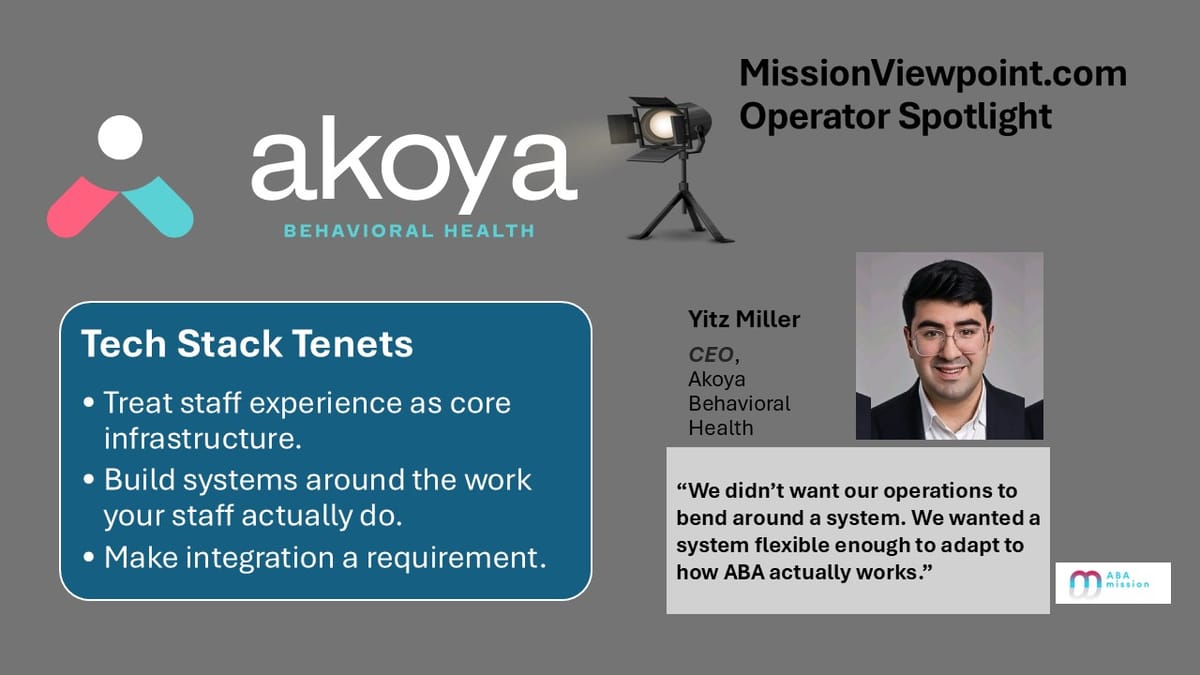
“We didn’t want our operations to bend around a system. We wanted a system flexible enough to adapt to how ABA actually works.”
Viventium aligned with that requirement — not because of any single feature, but because its flexibility reinforced Akoya’s philosophy:
- Onboarding customization that allowed Akoya to create a single, structured path
- Clear payroll outputs that reinforced transparency and trust
- Responsiveness and co-development that supported their evolving workflows
- Compatibility with their clinical and ATS tools without forcing them into rigid patterns
- Support for differentiated compensation structures that reflect real ABA roles
Viventium didn’t create Akoya’s operating model. It adapted to it.
A Single-Path Onboarding Experience
In most ABA organizations, new hires navigate several parallel systems: a training portal, an HRIS login, a credentialing link, clinical setup, forms, and whatever else the organization has adopted over time.
Akoya intentionally rejected that pattern.
Inside Viventium, they built a single-path onboarding journey that organizes:
- Akoya-specific training
- required Medicaid modules
- documentation via Formstack
- shadowing preparation
- cohort placement
- competency conversations with BCBAs
This structure reduces early cognitive load and sets expectations from the start.
COO Ian Santus emphasized that this is especially critical for RBTs, whose first impressions of the organization often determine whether they stay.
This isn’t about convenience. It’s about retention architecture.
Payroll That Builds Trust Through Clarity
ABA payroll is inherently complex: varied activities, differentiated pay, time tied to session data, and multiple roles in the same week.
With Lumary as their Practice Management layer, Akoya exports structured session payroll data. Viventium processes it cleanly and displays it to employees with a level of detail most ABA organizations never achieve.
As Ian noted:
“The level of detail on the paystub builds trust. People finally understand exactly what they’re getting paid for.”
This clarity reduces disputes, improves staff confidence, and removes hidden friction points that contribute to early turnover.
Integration as a Strategic Requirement — Not an IT Project
Akoya’s integration philosophy was simple:
- one onboarding experience
- no duplicate time entry
- clean data flow from clinical to payroll
- extensible credentialing and progression
- vendors willing to build, not just sell
Their tech stack — Viventium, Hi Rasmus, Lumary, and Apploi — was chosen because each platform reinforced the operating model Akoya had defined, not because of feature checklists.
Integrations weren’t a project. They were a condition for building the system they envisioned.
Culture Made Operational
Akoya pairs these systems with intentional, people-first practices:
- new-hire cohorts that build community
- structured clinic shadowing that reduces early ambiguity
- competency conversations that build confidence
- training buddies for remote markets
- transparent expectations and progression
The systems reinforce the model, but the culture makes it work.
What stands out is not that Akoya uses a sophisticated HRIS — but that they treated workforce health as a design problem when they were still early enough to fix it.
It’s the opposite of the reactive pattern that defines so much of ABA.
Closing Reflection: Lessons for Other Providers
Akoya’s approach offers three clear lessons:
1. Treat staff experience as core infrastructure. It’s not an HR concern — it’s foundational to clinical outcomes.
2. Build systems around the work your staff actually do. Not around the limitations of generic HR software.
3. Make integration a requirement. Operational friction is not inevitable — it’s a systems design failure.
Akoya understood these truths early.
They built for their people first — and because of that, they built a foundation for quality, stability, and scale.
Want more insights on tech, ops and data? Subscribe here