Provider SCUBA October 2026 Update
⚠️ Methodology Reminder
SCUBA = Scott's Completely Unscientific Behaviorist Assessment — a deliberately imperfect, directional look at staffing momentum across ABA providers.
This is not a census. LinkedIn undercounts direct-care staff, headcount lags payroll, and public job postings reflect intent more than execution. But across 160+ organizations tracked consistently over time, these signals continue to surface meaningful structural patterns in the ABA market.
🤿 October Snapshot — Was September a Warning Sign?
September was the first month in 2026 that made me wonder whether the caution surrounding the ABA market was finally appearing in the staffing data.
One in four providers had declined in LinkedIn headcount.
October offered a somewhat different picture.
Among 166 providers with comparable September and October observations:
- 105 increased headcount
- 22 were unchanged
- 39 declined
Aggregate LinkedIn headcount increased approximately 1.1% during the month.
That's a broader distribution of growth than September, when 86 providers increased and 42 declined.
But here's what I find more interesting.
Of the 42 providers that declined in September, only 13 declined again in October.
The other 29 stabilized or returned to growth.
That doesn't eliminate the concern. Nearly one in four providers still moved backward in October.
But it suggests we're not yet seeing a consistent group of providers contracting month after month.
September may have been a warning sign. October suggests the picture is more complicated.
📊 The Top 20 — Stable Rankings, Stronger Growth
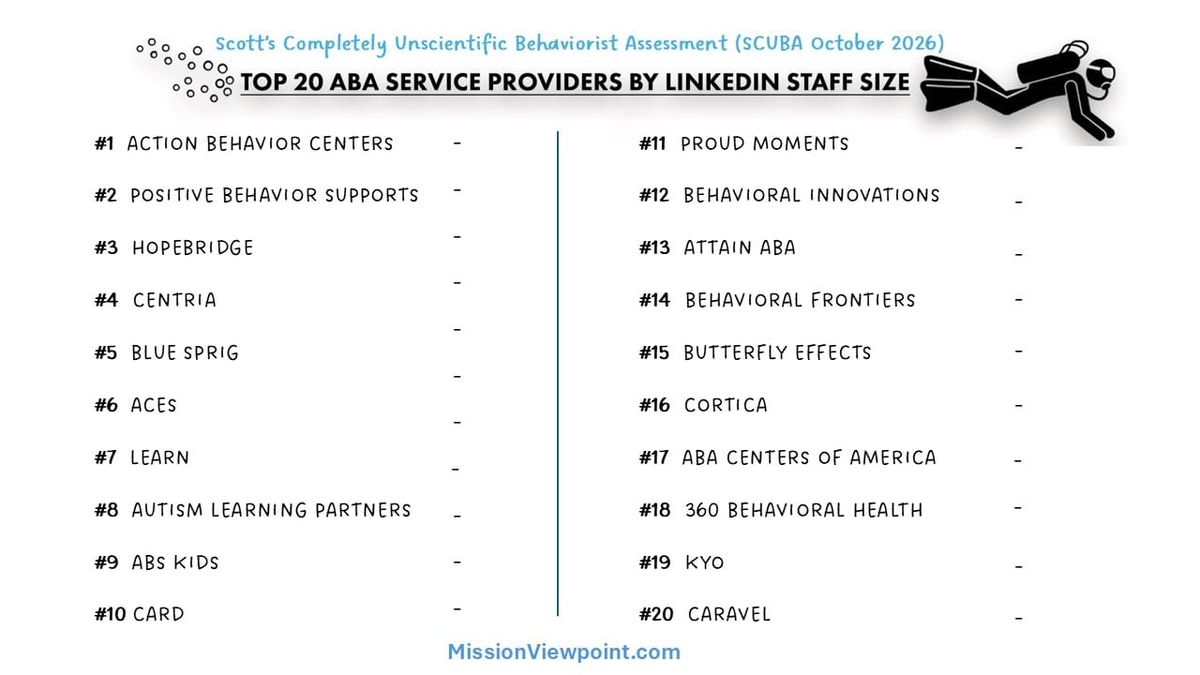
For the third consecutive month, the Top 20 rankings remained unchanged.
No new entrants. No position changes.
But the staffing picture improved underneath that stability.
In September, five of the Top 20 reported lower LinkedIn headcount.
In October, only two declined.
The other 18 added staff, and aggregate Top 20 headcount increased approximately 1% during the month.
Action Behavior Centers remains comfortably in the top position, followed by Positive Behavior Supports, Hopebridge and Centria.
The rankings haven't moved, but that doesn't mean the providers have stopped growing.
In fact, the largest organizations continue to account for a substantial share of the industry's staffing gains.
After September's softer results, October provides little evidence of a broad slowdown among the market leaders.
📈 The MVP Cohorts — Growth Beyond the Top 20
The MissionViewpoint MVP Cohorts are designed to identify providers with exceptional quarterly staffing growth, then track whether that momentum persists.
The Q3 2026 MVP Cohort includes:
- Elevation Autism
- The Treetop
- Lacuna Autism Services
- Children's Specialized ABA
- The Place for Children with Autism
All five began Q3 with fewer than 500 LinkedIn employees, making this an entirely mid-market cohort.
In October, four of the five continued adding staff.
Collectively, the cohort grew 2.8%, compared with approximately 1.1% across the broader provider sample.
All five remain above their June baseline, with combined growth of approximately 17% since the end of Q2.
The prior Q2 MVP Cohort also continued expanding in October, collectively adding approximately 1.4%.
(That cohort includes Action Behavior Centers, ABA Centers of America, Behavioral Framework, Golden Steps ABA and Brighter Strides ABA.)
Not every provider in either cohort grew this month. But both groups continued adding headcount overall.
The MVP cohorts are doing what I'd hoped they would: identifying growth that persists beyond the quarter in which the providers earned recognition.
And the Q3 group reinforces something we've seen throughout 2026: meaningful growth isn't confined to the industry's largest organizations.
🔎 A Market Under Greater Scrutiny
Recent Wall Street Journal reporting has brought renewed attention to treatment utilization, clinical justification, and accountability in ABA services.
I've covered those questions separately because they deserve more analysis than a staffing snapshot can provide.
But the scrutiny comes at a time when providers are already navigating reimbursement pressure, administrative complexity, and workforce challenges.
One question I'm increasingly interested in is whether those pressures eventually produce a more visible divergence in provider operating performance.
The staffing data already shows differences between organizations. What it doesn't tell us is why.
And that's an important limitation of SCUBA.
Provider SCUBA Takeaways — October 2026
- 105 of 166 providers added LinkedIn headcount, compared with 86 in September.
- 39 providers declined, but only 13 had also declined in September. Most of the previous month's decliners stabilized or returned to growth.
- Top 20 rankings remained unchanged for a third consecutive month, with 18 of the 20 adding headcount.
- The Q3 MVP Cohort grew 2.8% in October, outperforming the broader market and bringing its combined growth since June to approximately 17%.
- The Q2 MVP Cohort also continued expanding, adding approximately 1.4% during October.
- The broader questions around utilization, reimbursement and clinical justification remain unresolved, even as providers continue expanding their workforces.
Closing
September was the first month that made me seriously question whether the staffing data was beginning to reflect the caution I've been hearing across the ABA market.
October doesn't settle that question.
But it does provide some perspective.
More providers added employees. The Top 20 returned to broader growth. Both MVP cohorts continued expanding.
And most of the providers that declined in September didn't decline again.
That last point may be the most important.
A market where one in four providers reports a monthly staffing decline deserves attention.
A market where the same providers repeatedly contract would tell a more consequential story.
We're not seeing that pattern broadly yet.
For now, the ABA provider market continues to expand, even as the operating environment becomes more difficult.
The question heading into year-end isn't simply whether growth continues. It's whether the providers experiencing weakness begin to show a more persistent pattern.
If this analysis is useful, you can subscribe to receive future SCUBA updates and related insights through the MissionViewpoint newsletter.