What CAQH's Move to DataSpring Means for ABA Provider Data

CAQH's transition to DataSpring has generated considerable discussion across healthcare.
Much of that discussion has focused on a single concern: that greater payor involvement in provider data could eventually lead to tighter credentialing oversight, more aggressive claim reviews or expanded recoupment efforts.
Whether those concerns ultimately prove warranted remains to be seen.
But they raise a more immediate question for ABA providers:
How well does your organization actually know its own provider data?
Credentialing Doesn't Sit in Isolation
- Credentialing sits at the top of an operational chain.
- Credentialing affects contracting.
- Contracting affects authorizations.
- Authorizations affect scheduling.
- Scheduling affects billing.
- Billing affects reimbursement.
A single provider record—one BCBA's enrollment status with one payor—can quietly break each link in that chain if it's wrong, expired, or inconsistent across systems.
The issue isn't simply whether a provider is credentialed.
It's whether every system that depends on that information agrees.
Why ABA Is Different
ABA doesn't credential a handful of physicians.
It manages a workforce built around BCBAs, RBTs, supervision requirements, and meaningful clinician turnover.
A single BCBA may supervise dozens of clients and multiple technicians over time. Supervision relationships change. RBT assignments shift. Credentials renew on different schedules across different states and payors.
Unlike many healthcare specialties, a single BCBA may ultimately be associated with thousands of billable services over the course of a year through direct care, supervision, and authorization responsibilities. A seemingly small inconsistency in provider data can therefore affect a much larger operational footprint than many organizations realize.
As organizations scale, provider data also becomes increasingly fragmented.
- HR owns employment status.
- Credentialing owns enrollment.
- Learning management systems track required training and competencies.
- Practice management platforms schedule care and document services.
- Billing systems submit claims.
Every system owns part of the provider record.
None owns the complete provider record.
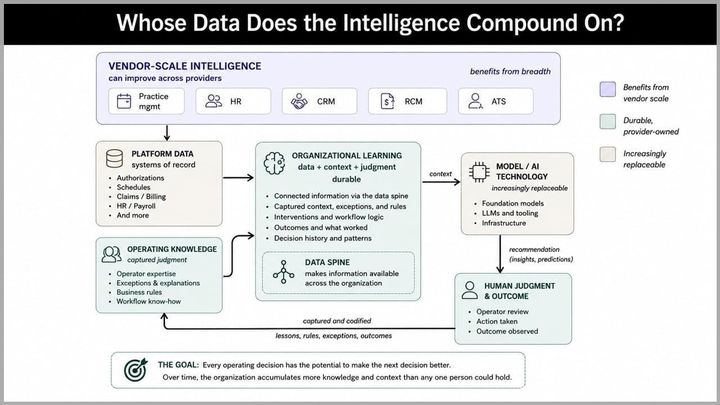
Without a provider data spine that reconciles those records into a consistent historical view, each system gradually develops its own version of reality.
The Questions That Reveal the Gap
Imagine a payor questions services billed six months ago by one BCBA.
Could your organization reconstruct exactly what was true on the date those services were delivered?
Not just today's records—but the historical state.
Could you demonstrate:
- Which providers were credentialed with which payors on a specific historical date?
- Which BCBA was supervising a case when services were delivered?
- Which RBTs were working under that supervision structure?
- Which claims are associated with providers who had enrollment gaps, expired credentials, or lapsed re-attestations?
- Where do your HR, credentialing, learning management, scheduling, billing, and practice management systems disagree about the same provider?
Most organizations can answer those questions eventually.
Far fewer can answer them confidently and quickly.
During an audit, "eventually" isn't very useful.
Start with One Provider
You don't need a new platform to understand whether you have a problem.
Pick one BCBA.
Pull every record your organization maintains for that person:
- HR
- Credentialing
- Learning management
- Practice management
- Billing
Then compare them.
Do they agree on:
- Credential status?
- Enrollment status?
- NPI?
- Effective dates?
- Active supervision assignments?
If those systems disagree about one provider, they probably disagree about many.
That exercise won't solve the problem.
But it will tell you whether you're dealing with isolated data quality issues or a broader governance problem.
If the Records Don't Match
If your systems disagree, resist the temptation to simply update whichever record looks wrong.
Instead:
- Determine which system should be the system of record for each provider attribute (employment, credentialing, training, enrollment, etc.).
- Identify how that information is supposed to flow to other systems.
- Understand why the discrepancy occurred. Was it a broken integration? A manual update? A missing process?
- Decide which historical data must be preserved rather than overwritten.
- Put a recurring reconciliation process in place rather than treating it as a one-time cleanup.
The goal isn't perfect data.
The goal is being able to explain, with confidence, what was true about a provider on any given date.
What DataSpring Really Signals
Whether or not DataSpring ultimately changes how payors approach credentialing, one trend seems clear.
Provider data is becoming more connected.
As external provider data becomes more complete and easier to reconcile, the gap between what a payor can determine about your providers and what your own organization can determine becomes increasingly important.
That isn't primarily a credentialing issue.
It's a data architecture issue.
The Longer-Term Implication
The providers most exposed to future audits and recoupment activity won't necessarily be the ones delivering poor clinical care.
They'll often be the organizations whose internal systems can't consistently answer basic questions about who was credentialed, who was supervising, and what was true at the time services were delivered.
That's a solvable problem.
But solving it requires treating provider data as operational infrastructure rather than administrative paperwork.
For many ABA providers, that starts with building a provider data spine—one that reconciles information across HR, credentialing, learning management, scheduling, billing, and practice management systems into a single, historically reliable operational record.