October 2026 Platform SCUBA Update
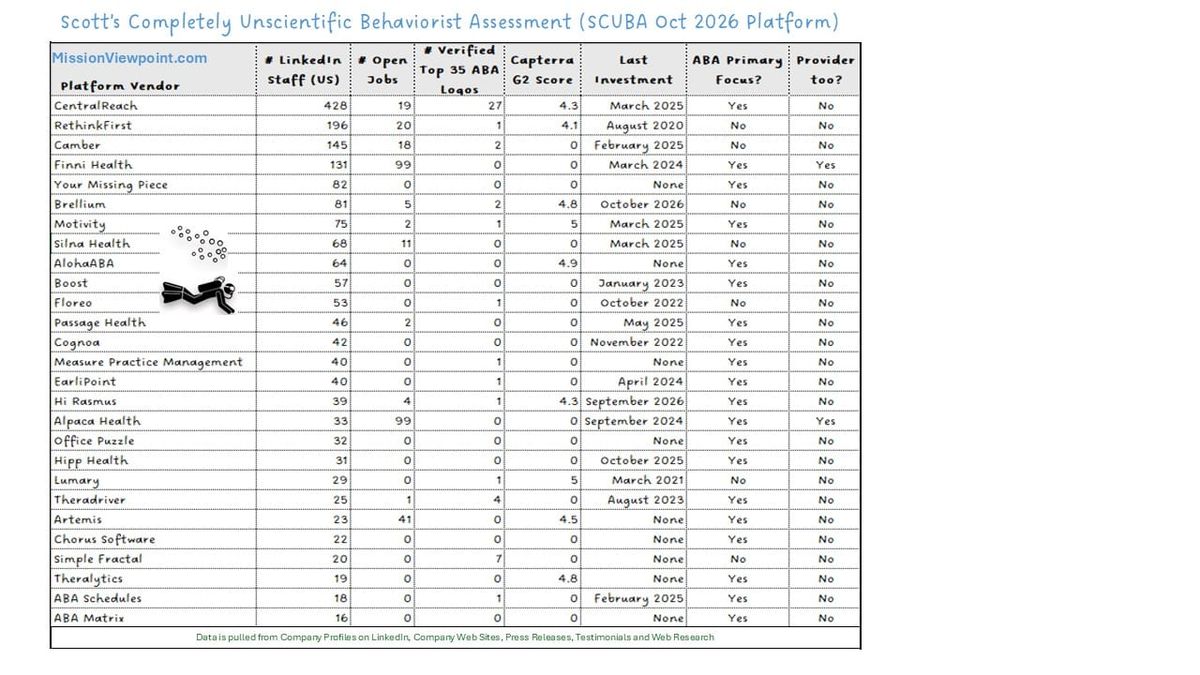
Theme: AI moves deeper into clinical workflows
Over the past several months, Platform SCUBA has tracked vendors making clearer choices about what they build, what they integrate, and where they compete.
October revealed another dimension of those choices.
AI is moving beyond generating session notes into diagnostic evaluations, reauthorization reporting, clinical compliance, and treatment delivery oversight. Some vendors are beginning to report measurable operational results, while others are investing in capabilities that extend well beyond ABA.
The distinction is becoming less about which platforms offer AI and more about
- where that technology fits into clinical and operational workflows,
- what decisions it supports, and
- whether providers can demonstrate meaningful results.
📉 Market Signals & Hiring Trends
Platform activity remains relatively steady, although investment in additional staff continues to be concentrated among a smaller group of vendors.
That contrasts with September's Provider SCUBA, where roughly one-quarter of tracked providers showed declining LinkedIn headcount.
The divergence is worth watching. While some providers appear to be slowing their workforce expansion, technology vendors continue investing in capabilities intended to improve efficiency, documentation, and revenue protection.
As always, LinkedIn headcount and hiring activity are directional signals, not precise measures of market performance.
🔎 Notable Signals from October
- Brellium raised an additional $23 million and introduced CortexLM to identify clinical documentation and compliance gaps. The company reports auditing 22 million visits and protecting $2 billion in provider revenue. Its expansion into additional healthcare specialties signals growing opportunities beyond ABA.
- CentralReach launched ReportDraftAI for progress and reauthorization reports and moved VoiceDraftAI into beta. The company also reported that NoteGuardAI processed more than 3 million notes across 400+ organizations in August, extending AI across multiple clinical documentation workflows.
- Frontera reported that its Diagnosis Builder reduced diagnostic report-writing time by 50% during a pilot at Action Behavior Centers. During the broader rollout, the percentage of initial evaluation reports completed on time increased approximately 25%.
- Motivity rolled out AI-generated session notes with organization-defined documentation standards and clinician review requirements, included at no additional cost. New session metrics also give supervisors greater visibility into programs delivered versus prescribed, connecting documentation with treatment execution.
- EarliPoint Health introduced an enhanced Developmental Progress Report measuring social disability, language comprehension, and nonverbal learning against peer samples. Replacing its previous report, the update expands EarliPoint's role in longitudinal developmental measurement beyond initial autism identification.
- Silna Health partnered with Forus to bring insurance verification into medication access workflows, extending its capabilities beyond ABA and behavioral health into another healthcare segment.
🔬 Beyond Generating Documentation
The most interesting development in October isn't the number of AI announcements. It's how differently the technology is being applied.
Frontera is reducing the administrative burden of diagnostic evaluations. CentralReach is assembling clinical data into reauthorization reports and reviewing notes for compliance gaps. Motivity is helping clinicians document sessions within organization-defined standards. Brellium is evaluating documentation against clinical and regulatory requirements.
These aren't interchangeable capabilities, and they don't necessarily compete with one another.
But they address different parts of a common operational challenge: how providers capture, organize, evaluate, and defend the clinical information supporting care delivery and reimbursement.
That challenge has become more consequential as payors increase scrutiny of documentation, medical necessity, and treatment intensity.
The distinction between generating a well-written note and demonstrating that care was clinically appropriate matters. AI may make documentation faster and more consistent, but neither improvement automatically establishes clinical quality or medical necessity.
🔀 Beyond the ABA Market
Brellium and Silna illustrate another development worth watching.
Some specialized vendors serving ABA are increasingly pursuing opportunities across broader healthcare markets.
Larger addressable markets can support additional investment in product development, infrastructure, and compliance capabilities that ABA customers may ultimately benefit from.
But that expansion also raises questions about how these companies will prioritize the specialized requirements of autism service providers.
A company can remain relevant to ABA without making ABA the center of its growth strategy.
For providers evaluating technology partners, that distinction may become increasingly important.
🧪 SCUBA Dataset Refreshed
This month's update continues to track:
- U.S. LinkedIn headcount
- Job postings
- Top-35 provider traction
- Investment history
- ABA market focus
- Public rating signals
SCUBA stands for Scott's Completely Unscientific Behaviorist Assessment.
It is a recurring, dataset-backed snapshot of activity across the autism services ecosystem—not a market-share study or scientific ranking. The goal is to combine imperfect but observable signals to better understand how the infrastructure supporting ABA care is evolving.
If this analysis is useful, you can subscribe to receive future SCUBA updates and related insights through the MissionViewpoint newsletter.
Feedback is always welcome. I appreciate corrections, clarifications, and additional data points from operators, vendors, and investors.