MissionViewpoint Monthly Update — November 2026

This Month’s Theme
Where Capital Is Betting on ABA
Reimbursement uncertainty has made provider economics hard to underwrite, and the largest ABA providers keep growing without combining with one another. Yet this fall, serious money kept moving into the technology around them.
This month’s three-part series works through that contradiction: why consolidation among the largest providers has stayed so quiet, what investors are actually betting on, and why those bets only pay off when providers decide where to spend their own money.
“The one thing a provider can’t afford to lose is control over the connection between its own records.”
And the Wall Street Journal made that control harder to put off — by building a utilization benchmark this market never built for itself.
Let’s get into it.
The Series
Where Capital Is Betting on ABA
ABA’s Missing Mergers
ABA looks like a market that should be consolidating: fragmented, growing, and a decade into private equity investment. Yet in more than two years of tracking the 35 largest providers, I haven’t identified a combination between two of them.
Ownership keeps changing, but recapitalizing a provider and integrating one are very different propositions. An acquirer takes on another organization’s systems, contracts, and data, along with the open question of how much of its revenue is truly settled.
The buyer isn’t simply acquiring revenue. It’s acquiring the processes and evidence supporting that revenue.
De novo expansion lets a provider extend a system it understands rather than pay for one it may need to substantially change. For some of the largest organizations, the hurdle for an acquisition may simply be getting higher.
Read →The Battle for ABA’s Tech Stack
Some large providers seem increasingly willing to seriously evaluate replacing their practice management systems. Capital is betting on more than that.
Picture a provider with fifty clinics whose Medicaid plan wants its treatment hours explained. Its clinicians believe the explanation exists. However, its systems can’t produce it consistently.
It has three paths: replace its PM system with a platform that brings clinical and operational capabilities together, as Motivity’s Calmanac acquisition illustrates; move a stack layer to a specialist, as Hi Rasmus’s data collection platform demonstrates; or add capabilities alongside the core, as Brellium does.
Capital is now supporting all three. The enterprise market is opening not simply because established systems are becoming easier to replace, but because more of the work they once controlled can be performed elsewhere.
Read →Investment Capital’s Bets on ABA
None of these bets produces a return until providers decide to spend. So where should the next provider dollar go?
New capital is improving clinical platforms, reimbursement protection, automation, and the connections between systems.
Providers don’t need to build all of those capabilities themselves. Some are worth ‘renting’ as software, others are better ‘outsourced’ and delivered by specialized partners.
But providers should retain control over the evidence and architecture that allow those decisions to change. That doesn’t mean every provider needs a data lake. It means retaining accountability for the integrity, accessibility, and portability of its information, wherever vendors store it.
It also puts an obligation on platforms. Challengers need to make migration from legacy systems practical. And vendors promising an escape from lock-in need to prove straightforward data access and interoperability, or they risk building another walled garden.
In a market where the technology stack is still changing, the ability to change your mind may be one of the most valuable capabilities a provider can retain.
Read → Watch Scott’s 90 seconds take on it here
ABA Never Built a Common Utilization Benchmark. The Wall Street Journal Did.
Sixty-nine children in Arizona’s Medicaid program switched to the same large provider. In the month before, they averaged about 13 hours of therapy a week. After switching, they averaged 24. The children hadn’t changed. The organization delivering care had.
The Journal’s analysis measures billed services, not clinical appropriateness, and claims say almost nothing about a child’s needs. That objection is fair.
But much of the missing evidence isn’t missing from the world. It’s sitting in provider systems that may not be able to turn it into evidence at scale, while every payor already holds comparable claims for its own members.
The provider who can’t produce its own benchmark gets judged by someone else’s.
Read →Brellium’s $23 Million Bet Beyond ABA — Without Leaving It Behind
Brellium raised $23 Million, led by Left Lane Capital, to expand into primary care and specialities such as cardiology. It also introduced CortexLM, its harness for identifying documentation, compliance, and care quality gaps. For ABA providers, that raises an obvious question: what happens to its investment in ABA?
“ABA absolutely remains a core market for Brellium,” co-founder and CEO Zach Rosen told me, pointing to deeper integrations with the platforms customers use.
The distinction to watch is whether correction and resolution happen inside the system where the note lives, or alongside it. The test is whether Brellium can deepen its value within ABA while pursuing those larger markets.
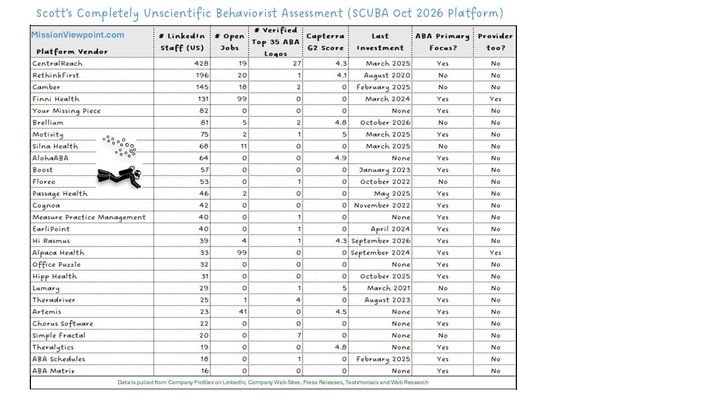
Read →🤿 SCUBA — Scott’s Completely Unscientific Behaviorist Assessment of where providers and platforms stand each month.
Was September a Warning Sign?
Most of September’s decliners didn’t decline again.
Last month, one in four providers moved backward, and I wondered whether the caution in the market had finally reached the staffing data.
October complicates that. Among 166 providers with comparable observations, 105 grew, 22 were flat, and 39 declined, with aggregate LinkedIn headcount up about 1.1%.
Of the 42 providers that declined in September, only 13 declined again. Nearly one in four still moved backward, but we’re not yet seeing a consistent group contracting month after month.
Underneath, the Top 20 rankings were unchanged for a third straight month, and 18 of the 20 added staff. The Q3 MVP Cohort introduced last month — Elevation Autism, The Treetop, Lacuna Autism Services, Children’s Specialized ABA, and The Place for Children with Autism — grew 2.8%, bringing its combined growth since June to about 17%. The Q2 cohort added about 1.4%.
The question heading into year-end isn’t simply whether growth continues. It’s whether the providers experiencing weakness begin to show a more persistent pattern.
Read the full Provider SCUBA →
AI Moves Deeper Into Clinical Workflows
Less about who offers AI. More about where it fits.
AI is moving beyond session notes into diagnostic evaluations, reauthorization reporting, clinical compliance, and treatment delivery oversight, and some vendors are starting to report measurable results.
- CentralReach launched ReportDraftAI for progress and reauthorization reports and moved VoiceDraftAI into beta.
- Frontera reported that Diagnosis Builder cut diagnostic report-writing time by 50% during a pilot at Action Behavior Centers.
- Motivity rolled out AI-generated session notes at no additional cost, with new metrics on programs delivered versus prescribed.
- EarliPoint Health introduced an enhanced Developmental Progress Report, extending its role into longitudinal measurement.
The other signal is traffic across ABA’s borders.
- Brellium and Silna Health are extending capabilities developed in ABA into broader healthcare markets.
- Candid Health, fresh off a $120 million Series D, is moving the other way, building ABA-specific billing capabilities on two and a half years of work with Cortica.
A company can remain relevant to ABA without making ABA the center of its growth strategy. For providers evaluating technology partners, understanding where ABA fits may become increasingly important.
Read the full Platform SCUBA →Closing Thoughts
Three articles, one subject: “Where Capital Is Betting on ABA”
The investment picture is changing. Provider consolidation remains quiet, while capital is financing new ways to compete for the technology spending of organizations that continue to grow.
But funding doesn’t settle which companies will win. Providers will determine that through the capabilities they adopt, the operational problems they prioritize, and the returns those investments actually deliver.
The next phase of ABA technology competition may be decided less by who raises the most capital than by who makes that capital useful to the organizations delivering care.
Until next time,
— Scott
P.S. I work with ABA providers, platforms, and investors on strategy, operations, and market positioning. If that’s relevant to your work, just reply to this email.
Upcoming Theme for Next Month’s Newsletter
Can You Explain Your Hours?
The Wall Street Journal used claims data to raise questions about ABA treatment intensity. But claims can show how many hours were billed, not why those hours were recommended, authorized, or delivered — or whether they remained appropriate as a patient’s needs changed.
ABA providers have much of the information needed to answer those questions. The challenge is connecting it, interpreting it, and acting on what it reveals.
We’ll work through three questions:
1Can you reconstruct why treatment hours increased, decreased, or stayed the same — connecting clinical recommendations, payor decisions, actual delivery, and patient progress over time?
2What could you learn about clinical progress, access to care, and organizational performance if you looked beyond utilization metrics — especially when hours are both a measure of production and a clinical decision?
3And who is accountable for acting on that evidence — including when clinical decisions conflict with financial incentives, or new information calls an earlier decision into question?